मराठी

If A(4, 9), B(2, 3) and C(6, 5) are the vertices of ∆ABC, then the length of median through C is - Mathematics

Advertisements
Advertisements

प्रश्न

If A(4, 9), B(2, 3) and C(6, 5) are the vertices of ∆ABC, then the length of median through C is

पर्याय

  • 5 units  

  • \[\sqrt{10}\] units                      


  • 25 units   

  •  10 units  

MCQ
Advertisements

उत्तर

It is given that A(4, 9), B(2, 3) and C(6, 5) are the vertices of ∆ABC. 
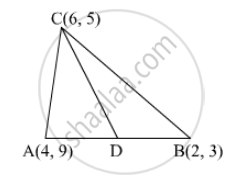
Let CD be the median of ∆ABC through C. Then, D is the mid-point of AB.

Using mid-point formula, we get

Coordinates of D = \[\left( \frac{4 + 2}{2}, \frac{9 + 3}{2} \right) = \left( \frac{6}{2}, \frac{12}{2} \right) = \left( 3, 6 \right)\]

∴ Length of the median, AD 

\[= \sqrt{\left( 6 - 3 \right)^2 + \left( 5 - 6 \right)^2} \left( \text{ Using distance formula } \right)\]
\[ = \sqrt{3^2 + \left( - 1 \right)^2}\]
\[ = \sqrt{10} \text{ units } \]

Thus, the length of the required median is \[\sqrt{10}\] units.


shaalaa.com
  या प्रश्नात किंवा उत्तरात काही त्रुटी आहे का?
पाठ 6: Co-Ordinate Geometry - Exercise 6.7 [पृष्ठ ६६]

APPEARS IN

आरडी शर्मा Mathematics [English] Class 10
पाठ 6 Co-Ordinate Geometry
Exercise 6.7 | Q 45 | पृष्ठ ६६

व्हिडिओ ट्यूटोरियलVIEW ALL [2]

संबंधित प्रश्‍न

If two opposite vertices of a square are (5, 4) and (1, −6), find the coordinates of its remaining two vertices.


Find the third vertex of a triangle, if two of its vertices are at (−3, 1) and (0, −2) and the centroid is at the origin.


Find the equation of the perpendicular bisector of the line segment joining points (7, 1) and (3,5).


Find the ratio in which the point (2, y) divides the line segment joining the points A (-2,2) and B (3, 7). Also, find the value of y.


Determine the ratio in which the point P (m, 6) divides the join of A(−4, 3) and B(2, 8). Also, find the value of m.


In what ratio does the line x - y - 2 = 0 divide the line segment joining the points A (3, 1) and B (8, 9)? 


The abscissa of a point is positive in the


 ABCD is a parallelogram with vertices  \[A ( x_1 , y_1 ), B \left( x_2 , y_2 \right), C ( x_3 , y_3 )\]   . Find the coordinates  of the fourth vertex D in terms of  \[x_1 , x_2 , x_3 , y_1 , y_2 \text{ and }  y_3\]


If (x, y) be on the line joining the two points (1, −3) and (−4, 2) , prove that x + y + 2= 0.


What is the area of the triangle formed by the points O (0, 0), A (6, 0) and B (0, 4)?


If the distance between the points (3, 0) and (0, y) is 5 units and y is positive. then what is the value of y?


If the centroid of the triangle formed by (7, x) (y, −6) and (9, 10) is at (6, 3), then (x, y) =


If the points(x, 4) lies on a circle whose centre is at the origin and radius is 5, then x =


 In Fig. 14.46, the area of ΔABC (in square units) is


What is the nature of the line which includes the points (-5, 5), (6, 5), (-3, 5), (0, 5)?


The line 3x + y – 9 = 0 divides the line joining the points (1, 3) and (2, 7) internally in the ratio ______.


Ordinate of all points on the x-axis is ______.


A point both of whose coordinates are negative will lie in ______.


Assertion (A): The ratio in which the line segment joining (2, -3) and (5, 6) internally divided by x-axis is 1:2.

Reason (R): as formula for the internal division is `((mx_2 + nx_1)/(m + n) , (my_2 + ny_1)/(m + n))`


Share
Notifications

Englishहिंदीमराठी


      Forgot password?
Use app×