Advertisements
Advertisements
Question
If A(4, 9), B(2, 3) and C(6, 5) are the vertices of ∆ABC, then the length of median through C is
Options
5 units
- \[\sqrt{10}\] units
25 units
10 units
Advertisements
Solution
It is given that A(4, 9), B(2, 3) and C(6, 5) are the vertices of ∆ABC.
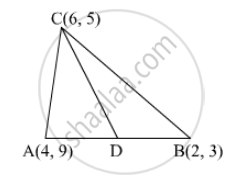
Let CD be the median of ∆ABC through C. Then, D is the mid-point of AB.
Using mid-point formula, we get
Coordinates of D = \[\left( \frac{4 + 2}{2}, \frac{9 + 3}{2} \right) = \left( \frac{6}{2}, \frac{12}{2} \right) = \left( 3, 6 \right)\]
∴ Length of the median, AD
\[= \sqrt{\left( 6 - 3 \right)^2 + \left( 5 - 6 \right)^2} \left( \text{ Using distance formula } \right)\]
\[ = \sqrt{3^2 + \left( - 1 \right)^2}\]
\[ = \sqrt{10} \text{ units } \]
Thus, the length of the required median is \[\sqrt{10}\] units.
APPEARS IN
RELATED QUESTIONS
A line intersects the y-axis and x-axis at the points P and Q respectively. If (2, –5) is the mid-point of PQ, then find the coordinates of P and Q.
On which axis do the following points lie?
R(−4,0)
Prove that the points (−2, 5), (0, 1) and (2, −3) are collinear.
Prove that the points (3, 0), (4, 5), (-1, 4) and (-2, -1), taken in order, form a rhombus.
Also, find its area.
In the seating arrangement of desks in a classroom three students Rohini, Sandhya and Bina are seated at A(3, 1), B(6, 4), and C(8, 6). Do you think they are seated in a line?
If the point P (2,2) is equidistant from the points A ( -2,K ) and B( -2K , -3) , find k. Also, find the length of AP.
The abscissa and ordinate of the origin are
The abscissa of a point is positive in the
If (a,b) is the mid-point of the line segment joining the points A (10, - 6) , B (k,4) and a - 2b = 18 , find the value of k and the distance AB.
Find the value of k, if the points A(7, −2), B (5, 1) and C (3, 2k) are collinear.
Find the value of a for which the area of the triangle formed by the points A(a, 2a), B(−2, 6) and C(3, 1) is 10 square units.
If the mid-point of the segment joining A (x, y + 1) and B (x + 1, y + 2) is C \[\left( \frac{3}{2}, \frac{5}{2} \right)\] , find x, y.
The coordinates of the point on X-axis which are equidistant from the points (−3, 4) and (2, 5) are
If the points P (x, y) is equidistant from A (5, 1) and B (−1, 5), then
The point on the x-axis which is equidistant from points (−1, 0) and (5, 0) is

In the above figure, seg PA, seg QB and RC are perpendicular to seg AC. From the information given in the figure, prove that: `1/x + 1/y = 1/z`
The point R divides the line segment AB, where A(−4, 0) and B(0, 6) such that AR=34AB.">AR = `3/4`AB. Find the coordinates of R.
If the coordinates of the two points are P(–2, 3) and Q(–3, 5), then (abscissa of P) – (abscissa of Q) is ______.
The perpendicular distance of the point P(3, 4) from the y-axis is ______.
In which ratio the y-axis divides the line segment joining the points (5, – 6) and (–1, – 4)?
