Advertisements
Advertisements
Question
The area of the triangle formed by the points A(2,0) B(6,0) and C(4,6) is
Options
24 sq. units
12 sq. units
10 sq. units
none of these
Advertisements
Solution
Given that points A(2,0), B(6,0) and C(4 ,6) form a triangle which is shown in the figure. We are asked to find the area of the triangle ΔABC.
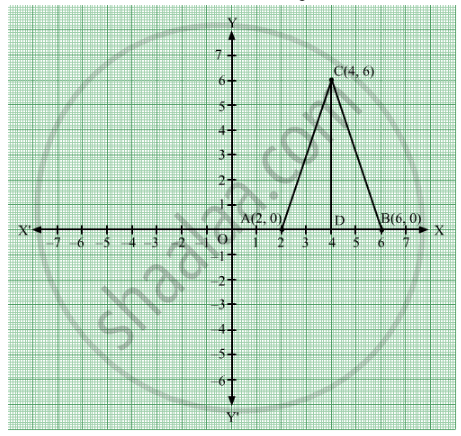
Given that
OA = 2
and OB = 6
Hence
\[\text { AB = OB - OA}\]
\[ = 6 - 2\]
\[ = 4\]
CD = 6
By using formula,
\[∆\text { ABC }= \frac{1}{2} \times \text { AB} \times \text{CD}\]
\[ = \frac{1}{2} \times 4 \times 6\]
\[ = 12 \text { sq units} \]
APPEARS IN
RELATED QUESTIONS
Show that the points A(5, 6), B(1, 5), C(2, 1) and D(6,2) are the vertices of a square.
Prove that the points (3, -2), (4, 0), (6, -3) and (5, -5) are the vertices of a parallelogram.
Three consecutive vertices of a parallelogram are (-2,-1), (1, 0) and (4, 3). Find the fourth vertex.
The midpoint of the line segment joining A (2a, 4) and B (-2, 3b) is C (1, 2a+1). Find the values of a and b.
Find the area of quadrilateral ABCD whose vertices are A(-3, -1), B(-2,-4) C(4,-1) and D(3,4)
If the vertices of ΔABC be A(1, -3) B(4, p) and C(-9, 7) and its area is 15 square units, find the values of p
If the centroid of the triangle formed by points P (a, b), Q(b, c) and R (c, a) is at the origin, what is the value of a + b + c?
If the centroid of the triangle formed by the points (a, b), (b, c) and (c, a) is at the origin, then a3 + b3 + c3 =
Which of the points P(-1, 1), Q(3, - 4), R(1, -1), S (-2, -3), T(-4, 4) lie in the fourth quadrant?
The points whose abscissa and ordinate have different signs will lie in ______.
