Advertisements
Advertisements
Question
The distance of the point P (4, 3) from the origin is
Options
4
3
5
7
Advertisements
Solution
The point P(4,3) is shown in the graph given below:
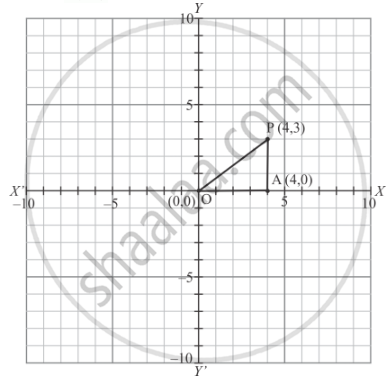
In ΔOAPis right angled triangle where
OA = 4
and AP =3
By using Pythagoras theorem:
`OP = sqrt(OA^2 + AP^2)`
` = sqrt(4^2 +3^2)`
`=sqrt(16 +9)`
`=sqrt25`
`=5`
Thus the distance of the point P(4,3) from the origin is 5.
APPEARS IN
RELATED QUESTIONS
Find a point on the x-axis which is equidistant from the points (7, 6) and (−3, 4).
The abscissa of a point is positive in the
Find the value of a for which the area of the triangle formed by the points A(a, 2a), B(−2, 6) and C(3, 1) is 10 square units.
If the points A(−1, −4), B(b, c) and C(5, −1) are collinear and 2b + c = 4, find the values of b and c.
If A(4, 9), B(2, 3) and C(6, 5) are the vertices of ∆ABC, then the length of median through C is
The points whose abscissa and ordinate have different signs will lie in ______.
The perpendicular distance of the point P(3, 4) from the y-axis is ______.
The coordinates of a point whose ordinate is `-1/2` and abscissa is 1 are `-1/2, 1`.
Find the coordinates of the point which lies on x and y axes both.
If the points P(1, 2), Q(0, 0) and R(x, y) are collinear, then find the relation between x and y.
Given points are P(1, 2), Q(0, 0) and R(x, y).
The given points are collinear, so the area of the triangle formed by them is `square`.
∴ `1/2 |x_1(y_2 - y_3) + x_2(y_3 - y_1) + x_3(y_1 - y_2)| = square`
`1/2 |1(square) + 0(square) + x(square)| = square`
`square + square + square` = 0
`square + square` = 0
`square = square`
Hence, the relation between x and y is `square`.
