Advertisements
Advertisements
Questions
If the vertices of ΔABC be A(1, -3) B(4, p) and C(-9, 7) and its area is 15 square units, find the values of p
If the vertices of a triangle are (1, −3), (4, p) and (−9, 7) and its area is 15 sq. units, find the value(s) of p?
Advertisements
Solution
`Let A(x_1,y_1)= A (1,-3),B(x_2,y_2)=B(4,P) and C (x_3,y_3)= C(-9,7) Now`
`"Area" (ΔABC) = 1/2[x_1(y_2-y_3)+x_2(y_3-y_1)+x_3(y_1-y_2)]`
`⇒15=1/2 [1(p-7)+4(7+3)-9(-3-p)]`
`⇒15=1/2[10p+60]`
`⇒ |10p +60|=30`
Therefore
⇒ 10p + 60 = -30 or 30
⇒ 10p = -90 or -30
⇒ p = -9 or -3
Hence , p= -9 or p= -3.
APPEARS IN
RELATED QUESTIONS
On which axis do the following points lie?
Q(0, -2)
Which point on the y-axis is equidistant from (2, 3) and (−4, 1)?
In Fig. 14.36, a right triangle BOA is given C is the mid-point of the hypotenuse AB. Show that it is equidistant from the vertices O, A and B.
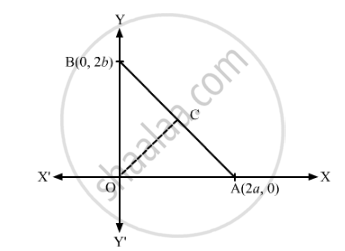
We have a right angled triangle,`triangle BOA` right angled at O. Co-ordinates are B (0,2b); A (2a, 0) and C (0, 0).
Find the point on x-axis which is equidistant from the points (−2, 5) and (2,−3).
If A and B are (1, 4) and (5, 2) respectively, find the coordinates of P when AP/BP = 3/4.
If the point C ( - 2,3) is equidistant form the points A (3, -1) and Bx (x ,8) , find the value of x. Also, find the distance between BC
Show that the following points are the vertices of a rectangle
A (0,-4), B(6,2), C(3,5) and D(-3,-1)
If the point `P (1/2,y)` lies on the line segment joining the points A(3, –5) and B(–7, 9) then find the ratio in which P divides AB. Also, find the value of y.
Find the ratio in which the point (-1, y) lying on the line segment joining points A(-3, 10) and (6, -8) divides it. Also, find the value of y.
Find the ratio in which the line segment joining the points A (3, 8) and B (–9, 3) is divided by the Y– axis.
Find the coordinates of the circumcentre of a triangle whose vertices are (–3, 1), (0, –2) and (1, 3).
If P (2, 6) is the mid-point of the line segment joining A(6, 5) and B(4, y), find y.
The coordinates of the point on X-axis which are equidistant from the points (−3, 4) and (2, 5) are
If A (5, 3), B (11, −5) and P (12, y) are the vertices of a right triangle right angled at P, then y=
The ratio in which (4, 5) divides the join of (2, 3) and (7, 8) is
Any point on the line y = x is of the form ______.
Find the point on the y-axis which is equidistant from the points (5, −2) and (−3, 2).
If the sum of X-coordinates of the vertices of a triangle is 12 and the sum of Y-coordinates is 9, then the coordinates of centroid are ______.
Find the coordinates of the point whose abscissa is 5 and which lies on x-axis.
The coordinates of the point where the line 2y = 4x + 5 crosses x-axis is ______.
