English

In Fig. 14.36, a Right Triangle Boa is Given C is the Mid-point of the Hypotenuse Ab. Show that It is Equidistant from the Vertices O, a and B. - Mathematics

Advertisements
Advertisements

Question

In Fig. 14.36, a right triangle BOA is given C is the mid-point of the hypotenuse AB. Show that it is equidistant from the vertices O, A  and B. 
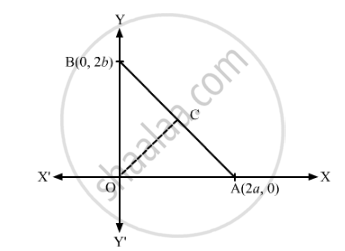
    

We have a right angled triangle,`triangle BOA`  right angled at O. Co-ordinates are B (0,2b); A (2a0) and C (0, 0).


Advertisements

Solution

We have to prove that mid-point C of hypotenuse AB is equidistant from the vertices.

In general to find the mid-pointP(x,y)  of two points`A(x_1,y_1)`and `B (x_2,y_2)` we use section formula as, 

`p(x,y)=((x_1+x_2)/2,(y_1+y_2)/2)` 

So co-rdinates of C is , 

C (a,b) 

In general, the distance between` A(x_1,y_2)` and `B(x_2,y_2)`is given by, 

`AB=sqrt((x_2-x_1)^2+(y_2-y_1)^2)` 

So, 

`CO=sqrt((a-0)^2+(b0o)^2)` 

`=sqrt(a^2+b^2)`

`CB =sqrt((a-0)^2+(b-2b)^2)` 

`sqrt(a^2+b^2)` 

`CA=sqrt((a-2a)^2+(b-0)^2)

`sqrt(a^2+b^2` 

Hence, mid-point  C of hypotenuse AB is equidistant from the vertices.

shaalaa.com
  Is there an error in this question or solution?
Chapter 6: Co-Ordinate Geometry - Exercise 6.4 [Page 37]

APPEARS IN

RD Sharma Mathematics [English] Class 10
Chapter 6 Co-Ordinate Geometry
Exercise 6.4 | Q 10 | Page 37

Video TutorialsVIEW ALL [2]

RELATED QUESTIONS

Find the point on x-axis which is equidistant from the points (−2, 5) and (2,−3).


If the points A (a, -11), B (5, b), C (2, 15) and D (1, 1) are the vertices of a parallelogram ABCD, find the values of a and b.


If A and B are (1, 4) and (5, 2) respectively, find the coordinates of P when AP/BP = 3/4.


If the point ( x,y ) is equidistant form the points ( a+b,b-a ) and (a-b ,a+b ) , prove that bx = ay


Find the coordinates of the midpoints of the line segment joining

A(3,0) and B(-5, 4)


Point P(x, 4) lies on the line segment joining the points A(−5, 8) and B(4, −10). Find the ratio in which point P divides the line segment AB. Also find the value of x.


 Prove hat the points A (2, 3) B(−2,2) C(−1,−2), and D(3, −1) are the vertices of a square ABCD.


If the points A(1, –2), B(2, 3) C(a, 2) and D(– 4, –3) form a parallelogram, find the value of a and height of the parallelogram taking AB as base.  


\[A\left( 6, 1 \right) , B(8, 2) \text{ and }  C(9, 4)\] are three vertices of a parallelogram ABCD . If E is the mid-point  of DC , find the area of  \[∆\] ADE.


If A (5, 3), B (11, −5) and P (12, y) are the vertices of a right triangle right angled at P, then y=


If points (a, 0), (0, b) and (1, 1)  are collinear, then \[\frac{1}{a} + \frac{1}{b} =\]


If the centroid of the triangle formed by (7, x) (y, −6) and (9, 10) is at (6, 3), then (x, y) =


The distance of the point (4, 7) from the y-axis is


The coordinates of a point on x-axis which lies on the perpendicular bisector of the line segment joining the points (7, 6) and (−3, 4) are


If point P is midpoint of segment joining point A(– 4, 2) and point B(6, 2), then the coordinates of P are ______


The line 3x + y – 9 = 0 divides the line joining the points (1, 3) and (2, 7) internally in the ratio ______.


Point (–10, 0) lies ______.


The perpendicular distance of the point P(3, 4) from the y-axis is ______.


In which ratio the y-axis divides the line segment joining the points (5, – 6) and (–1, – 4)?


Share
Notifications

Englishहिंदीमराठी


      Forgot password?
Use app×