Advertisements
Advertisements
प्रश्न
In Fig. 14.36, a right triangle BOA is given C is the mid-point of the hypotenuse AB. Show that it is equidistant from the vertices O, A and B.
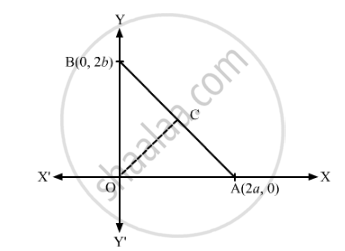
We have a right angled triangle,`triangle BOA` right angled at O. Co-ordinates are B (0,2b); A (2a, 0) and C (0, 0).
Advertisements
उत्तर
We have to prove that mid-point C of hypotenuse AB is equidistant from the vertices.
In general to find the mid-pointP(x,y) of two points`A(x_1,y_1)`and `B (x_2,y_2)` we use section formula as,
`p(x,y)=((x_1+x_2)/2,(y_1+y_2)/2)`
So co-rdinates of C is ,
C (a,b)
In general, the distance between` A(x_1,y_2)` and `B(x_2,y_2)`is given by,
`AB=sqrt((x_2-x_1)^2+(y_2-y_1)^2)`
So,
`CO=sqrt((a-0)^2+(b0o)^2)`
`=sqrt(a^2+b^2)`
`CB =sqrt((a-0)^2+(b-2b)^2)`
`sqrt(a^2+b^2)`
`CA=sqrt((a-2a)^2+(b-0)^2)
`sqrt(a^2+b^2`
Hence, mid-point C of hypotenuse AB is equidistant from the vertices.
APPEARS IN
संबंधित प्रश्न
The line segment joining the points P(3, 3) and Q(6, -6) is trisected at the points A and B such that Ais nearer to P. If A also lies on the line given by 2x + y + k = 0, find the value of k.
If the points A (a, -11), B (5, b), C (2, 15) and D (1, 1) are the vertices of a parallelogram ABCD, find the values of a and b.
If the coordinates of the mid-points of the sides of a triangle be (3, -2), (-3, 1) and (4, -3), then find the coordinates of its vertices.
If the poin A(0,2) is equidistant form the points B (3, p) and C (p ,5) find the value of p. Also, find the length of AB.
If p(x , y) is point equidistant from the points A(6, -1) and B(2,3) A , show that x – y = 3
The midpoint of the line segment joining A (2a, 4) and B (-2, 3b) is C (1, 2a+1). Find the values of a and b.
Find the area of a quadrilateral ABCD whose vertices area A(3, -1), B(9, -5) C(14, 0) and D(9, 19).
ABCD is a parallelogram with vertices \[A ( x_1 , y_1 ), B \left( x_2 , y_2 \right), C ( x_3 , y_3 )\] . Find the coordinates of the fourth vertex D in terms of \[x_1 , x_2 , x_3 , y_1 , y_2 \text{ and } y_3\]
Find the value of k if points A(k, 3), B(6, −2) and C(−3, 4) are collinear.
If \[D\left( - \frac{1}{5}, \frac{5}{2} \right), E(7, 3) \text{ and } F\left( \frac{7}{2}, \frac{7}{2} \right)\] are the mid-points of sides of \[∆ ABC\] , find the area of \[∆ ABC\] .
Write the perimeter of the triangle formed by the points O (0, 0), A (a, 0) and B (0, b).
If P (x, 6) is the mid-point of the line segment joining A (6, 5) and B (4, y), find y.
Find the area of triangle with vertices ( a, b+c) , (b, c+a) and (c, a+b).
If the points A (1,2) , O (0,0) and C (a,b) are collinear , then find a : b.
If points A (5, p) B (1, 5), C (2, 1) and D (6, 2) form a square ABCD, then p =
In Fig. 14.46, the area of ΔABC (in square units) is

Find the point on the y-axis which is equidistant from the points (5, −2) and (−3, 2).
What are the coordinates of origin?
The coordinates of two points are P(4, 5) and Q(–1, 6). Find the difference between their abscissas.
If the vertices of a parallelogram PQRS taken in order are P(3, 4), Q(–2, 3) and R(–3, –2), then the coordinates of its fourth vertex S are ______.
