Advertisements
Advertisements
प्रश्न
`"Find the ratio in which the poin "p (3/4 , 5/12) " divides the line segment joining the points "A (1/2,3/2) and B (2,-5).`
Advertisements
उत्तर
`"Let k : 1 be the ratio in which the point "p (3/4 , 5/12) " divides the line segment joining the points "A (1/2,3/2) and B (2,-5).` Then
`(3/4 , 5/12) = ((k(2)+1/2)/(k+1) , (k(-5)+2/2)/(k+1))`
` ⇒(k (2) +1/2)/(k+1) = 3/4 and (k(-5) +3/2) /(k+1) = 5/12`
`⇒ 8k+2=3k+3 and -60k +18 = 5k +5`
`⇒k=1/5 and k = 1/5 `
Hence, the required ratio is1:5
APPEARS IN
संबंधित प्रश्न
On which axis do the following points lie?
R(−4,0)
Prove that the points (−2, 5), (0, 1) and (2, −3) are collinear.
Find the value of x such that PQ = QR where the coordinates of P, Q and R are (6, -1), (1, 3) and (x, 8) respectively.
Find the points of trisection of the line segment joining the points:
5, −6 and (−7, 5),
Find the ratio in which the line segment joining (-2, -3) and (5, 6) is divided by y-axis. Also, find the coordinates of the point of division in each case.
If the poin A(0,2) is equidistant form the points B (3, p) and C (p ,5) find the value of p. Also, find the length of AB.
If the points p (x, y) is point equidistant from the points A (5, 1)and B (–1, 5), Prove that 3x = 2y
The co-ordinates of point A and B are 4 and -8 respectively. Find d(A, B).
The abscissa of any point on y-axis is
If the point P (m, 3) lies on the line segment joining the points \[A\left( - \frac{2}{5}, 6 \right)\] and B (2, 8), find the value of m.
If the points A(−2, 1), B(a, b) and C(4, −1) ae collinear and a − b = 1, find the values of aand b.
\[A\left( 6, 1 \right) , B(8, 2) \text{ and } C(9, 4)\] are three vertices of a parallelogram ABCD . If E is the mid-point of DC , find the area of \[∆\] ADE.
Find the values of x for which the distance between the point P(2, −3), and Q (x, 5) is 10.
Write the ratio in which the line segment doining the points A (3, −6), and B (5, 3) is divided by X-axis.
If the points(x, 4) lies on a circle whose centre is at the origin and radius is 5, then x =
In Fig. 14.46, the area of ΔABC (in square units) is
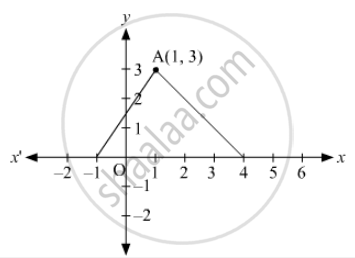
If P(2, 4), Q(0, 3), R(3, 6) and S(5, y) are the vertices of a parallelogram PQRS, then the value of y is
If A(x, 2), B(−3, −4) and C(7, −5) are collinear, then the value of x is
What is the form of co-ordinates of a point on the X-axis?
Abscissa of a point is positive in ______.
