Advertisements
Advertisements
प्रश्न
A point whose abscissa is −3 and ordinate 2 lies in
विकल्प
First quadrant
Second quadrant
Third quadrant
Fourth quadrant
Advertisements
उत्तर
As we know that
In the first quadrant x > 0, y >0
In the second quadrant x < 0 , y > 0
In the third quadrant x < 0 y < 0
In the fourth quadrant x > 0,y < 0
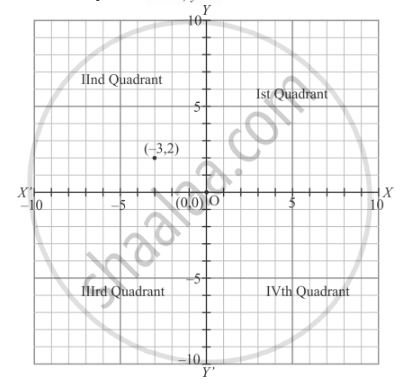
The point whose abscissa is −3 which is negative and ordinate 2 is positive, so this point lies in the second quadrant.
APPEARS IN
संबंधित प्रश्न
On which axis do the following points lie?
R(−4,0)
Find the centre of the circle passing through (5, -8), (2, -9) and (2, 1).
Find the points of trisection of the line segment joining the points:
(3, -2) and (-3, -4)
In what ratio is the line segment joining (-3, -1) and (-8, -9) divided at the point (-5, -21/5)?
Show that the following points are the vertices of a square:
A(0, –2), B(3, 1), C(0, 4) and D(–3, 1)
The midpoint P of the line segment joining the points A(–10, 4) and B(–2, 0) lies on the line segment joining the points C(–9, –4) and D(–4, y). Find the ratio in which P divides CD. Also, find the value of y.
Show that A(-4, -7), B(-1, 2), C(8, 5) and D(5, -4) are the vertices of a
rhombus ABCD.
A point whose abscissa and ordinate are 2 and −5 respectively, lies in
Find the distance between the points \[\left( - \frac{8}{5}, 2 \right)\] and \[\left( \frac{2}{5}, 2 \right)\] .
A line segment is of length 10 units. If the coordinates of its one end are (2, −3) and the abscissa of the other end is 10, then its ordinate is
