Advertisements
Advertisements
Question
A point whose abscissa is −3 and ordinate 2 lies in
Options
First quadrant
Second quadrant
Third quadrant
Fourth quadrant
Advertisements
Solution
As we know that
In the first quadrant x > 0, y >0
In the second quadrant x < 0 , y > 0
In the third quadrant x < 0 y < 0
In the fourth quadrant x > 0,y < 0
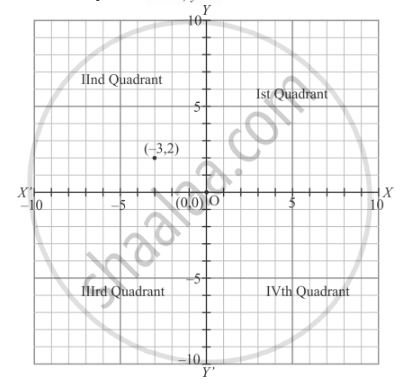
The point whose abscissa is −3 which is negative and ordinate 2 is positive, so this point lies in the second quadrant.
APPEARS IN
RELATED QUESTIONS
The base PQ of two equilateral triangles PQR and PQR' with side 2a lies along y-axis such that the mid-point of PQ is at the origin. Find the coordinates of the vertices R and R' of the triangles.
Show that the points A(–3, 2), B(–5, –5), C(2, –3) and D(4, 4) are the vertices of a rhombus. Find the area of this rhombus.
HINT: Area of a rhombus = `1/2` × (product of its diagonals).
Show that the points A (1, 0), B (5, 3), C (2, 7) and D (−2, 4) are the vertices of a parallelogram.
If the point P(2, 2) is equidistant from the points A(–2, k) and B(–2k, –3), find k. Also, find the length of AP.
Find the area of the triangle formed by joining the midpoints of the sides of the triangle whose vertices are A(2, 1), B(4, 3) and C(2, 5).
Write the coordinates of a point on X-axis which is equidistant from the points (−3, 4) and (2, 5).
If (−1, 2), (2, −1) and (3, 1) are any three vertices of a parallelogram, then
In which quadrant does the point (-4, -3) lie?
Find the coordinates of the point of intersection of the graph of the equation x = 2 and y = –3.
Signs of the abscissa and ordinate of a point in the second quadrant are respectively.
