Advertisements
Advertisements
प्रश्न
`"Find the ratio in which the poin "p (3/4 , 5/12) " divides the line segment joining the points "A (1/2,3/2) and B (2,-5).`
Advertisements
उत्तर
`"Let k : 1 be the ratio in which the point "p (3/4 , 5/12) " divides the line segment joining the points "A (1/2,3/2) and B (2,-5).` Then
`(3/4 , 5/12) = ((k(2)+1/2)/(k+1) , (k(-5)+2/2)/(k+1))`
` ⇒(k (2) +1/2)/(k+1) = 3/4 and (k(-5) +3/2) /(k+1) = 5/12`
`⇒ 8k+2=3k+3 and -60k +18 = 5k +5`
`⇒k=1/5 and k = 1/5 `
Hence, the required ratio is1:5
APPEARS IN
संबंधित प्रश्न
If A(–2, 1), B(a, 0), C(4, b) and D(1, 2) are the vertices of a parallelogram ABCD, find the values of a and b. Hence find the lengths of its sides
Find the coordinates of the point where the diagonals of the parallelogram formed by joining the points (-2, -1), (1, 0), (4, 3) and(1, 2) meet
Prove that the points (4, 5) (7, 6), (6, 3) (3, 2) are the vertices of a parallelogram. Is it a rectangle.
If the point C ( - 2,3) is equidistant form the points A (3, -1) and Bx (x ,8) , find the value of x. Also, find the distance between BC
If the point P (2,2) is equidistant from the points A ( -2,K ) and B( -2K , -3) , find k. Also, find the length of AP.
If the point `P (1/2,y)` lies on the line segment joining the points A(3, –5) and B(–7, 9) then find the ratio in which P divides AB. Also, find the value of y.
The distance of the point P (4, 3) from the origin is
If (0, −3) and (0, 3) are the two vertices of an equilateral triangle, find the coordinates of its third vertex.
Show that A (−3, 2), B (−5, −5), C (2,−3), and D (4, 4) are the vertices of a rhombus.
Find the centroid of the triangle whose vertices is (−2, 3) (2, −1) (4, 0) .
Write the perimeter of the triangle formed by the points O (0, 0), A (a, 0) and B (0, b).
Write the ratio in which the line segment doining the points A (3, −6), and B (5, 3) is divided by X-axis.
Find the value of a so that the point (3, a) lies on the line represented by 2x − 3y + 5 = 0
If P (x, 6) is the mid-point of the line segment joining A (6, 5) and B (4, y), find y.
If P is a point on x-axis such that its distance from the origin is 3 units, then the coordinates of a point Q on OY such that OP = OQ, are
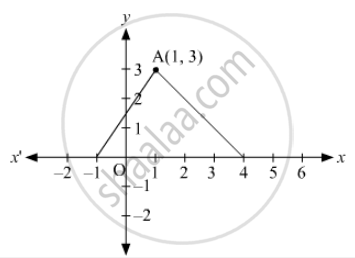
In Fig. 14.46, the area of ΔABC (in square units) is
Write the X-coordinate and Y-coordinate of point P(–5, 4).
Ordinate of all points on the x-axis is ______.
If the coordinate of point A on the number line is –1 and that of point B is 6, then find d(A, B).
If the vertices of a parallelogram PQRS taken in order are P(3, 4), Q(–2, 3) and R(–3, –2), then the coordinates of its fourth vertex S are ______.
