हिंदी

A ( 6 , 1 ) , B ( 8 , 2 ) and C ( 9 , 4 ) Are Three Vertices of a Parallelogram Abcd . If E is the Mid-point of Dc , Find the Area of δ Ade. - Mathematics

Advertisements
Advertisements

प्रश्न

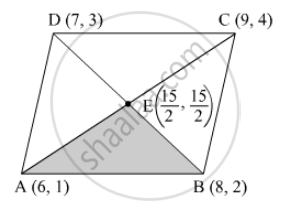
\[A\left( 6, 1 \right) , B(8, 2) \text{ and }  C(9, 4)\] are three vertices of a parallelogram ABCD . If E is the mid-point  of DC , find the area of  \[∆\] ADE.

 
संक्षेप में उत्तर
Advertisements

उत्तर

Three vertices are given, then D can be calulated and it comes out to be (7, 3).
Since, E is midpoint of BD.
Therefore, coordinates of E are  \[\left( \frac{15}{2}, \frac{5}{2} \right)\] .

Now, vertices of triangle ABE rae (6, 1), (8, 2) and \[\left( \frac{15}{2}, \frac{5}{2} \right)\] . 

\[\Rightarrow \text{ Area of the ∆ ABE } = \frac{1}{2}\begin{vmatrix}1 & 6 & 1 \\ 1 & 8 & 2 \\ 1 & \frac{15}{2} & \frac{5}{2}\end{vmatrix}\]

\[ = \frac{1}{2}\left[ 1\left( 20 - 15 \right) - 6\left( \frac{5}{2} - 2 \right) + 1\left( \frac{15}{2} - 8 \right) \right]\]

\[ = \frac{1}{2}\left[ 5 - \frac{6}{2} - \frac{1}{2} \right]\]

\[ = \frac{3}{4} \text{ aq . units } \]

shaalaa.com
  क्या इस प्रश्न या उत्तर में कोई त्रुटि है?
अध्याय 6: Co-Ordinate Geometry - Exercise 6.5 [पृष्ठ ५५]

APPEARS IN

आरडी शर्मा Mathematics [English] Class 10
अध्याय 6 Co-Ordinate Geometry
Exercise 6.5 | Q 34 | पृष्ठ ५५

वीडियो ट्यूटोरियलVIEW ALL [2]

संबंधित प्रश्न

Find a point on y-axis which is equidistant from the points (5, -2) and (-3, 2).


Find the ratio in which the line segment joining (-2, -3) and (5, 6) is divided by x-axis Also, find the coordinates of the point of division in each case.


Show that the points A (1, 0), B (5, 3), C (2, 7) and D (−2, 4) are the vertices of a parallelogram.


Find the ratio in which the pint (-3, k) divide the join of A(-5, -4) and B(-2, 3),Also, find the value of k.


In what ratio is the line segment joining the points A(-2, -3) and B(3,7) divided by the yaxis? Also, find the coordinates of the point of division.


If the point `P (1/2,y)` lies on the line segment joining the points A(3, -5) and B(-7, 9) then find the ratio in which P divides AB. Also, find the value of y.


Find the ratio in which the line segment joining the points A (3, 8) and B (–9, 3) is divided by the Y– axis.


Point P(x, 4) lies on the line segment joining the points A(−5, 8) and B(4, −10). Find the ratio in which point P divides the line segment AB. Also find the value of x.


If the points P, Q(x, 7), R, S(6, y) in this order divide the line segment joining A(2, p) and B(7, 10) in 5 equal parts, find xy and p


Points P, Q, R and S divides the line segment joining A(1, 2) and B(6, 7) in 5 equal parts. Find the coordinates of the points P, Q and R.   


If P (2, 6) is the mid-point of the line segment joining A(6, 5) and B(4, y), find y. 


The distance between the points (a cos θ + b sin θ, 0) and (0, a sin θ − b cos θ) is


The distance of the point (4, 7) from the x-axis is


 In Fig. 14.46, the area of ΔABC (in square units) is


Which of the points P(-1, 1), Q(3, - 4), R(1, -1), S (-2, -3), T(-4, 4) lie in the fourth quadrant?


The point R divides the line segment AB, where A(−4, 0) and B(0, 6) such that AR=34AB.">AR = `3/4`AB. Find the coordinates of R.


The distance of the point P(2, 3) from the x-axis is ______.


Ordinate of all points on the x-axis is ______.


Which of the points P(0, 3), Q(1, 0), R(0, –1), S(–5, 0), T(1, 2) do not lie on the x-axis?


A tiling or tessellation of a flat surface is the covering of a plane using one or more geometric shapes, called tiles, with no overlaps and no gaps. Historically, tessellations were used in ancient Rome and in Islamic art. You may find tessellation patterns on floors, walls, paintings etc. Shown below is a tiled floor in the archaeological Museum of Seville, made using squares, triangles and hexagons.

A craftsman thought of making a floor pattern after being inspired by the above design. To ensure accuracy in his work, he made the pattern on the Cartesian plane. He used regular octagons, squares and triangles for his floor tessellation pattern


Use the above figure to answer the questions that follow:

  1. What is the length of the line segment joining points B and F?
  2. The centre ‘Z’ of the figure will be the point of intersection of the diagonals of quadrilateral WXOP. Then what are the coordinates of Z?
  3. What are the coordinates of the point on y-axis equidistant from A and G?
    OR
    What is the area of Trapezium AFGH?

Share
Notifications

Englishहिंदीमराठी


      Forgot password?
Use app×