Advertisements
Advertisements
प्रश्न
If three consecutive vertices of a parallelogram are (1, -2), (3, 6) and (5, 10), find its fourth vertex.
If three consecutive vertices of a parallelogram ABCD are A (1,-2) , B (3,6) and C(5,10) find its fourth vertex D.
Advertisements
उत्तर १
Let ABCD be a parallelogram in which the coordinates of the vertices are A (1,−2);
B (3, 6) and C(5, 10). We have to find the coordinates of the fourth vertex.
Let the fourth vertex be D(x,y)
Since ABCD is a parallelogram, the diagonals bisect each other. Therefore the mid-point of the diagonals of the parallelogram will coincide.
Now to find the mid-point P(x,y) of two points `A(x_1, y_1)` and `B(x_2,y_1)` we use section formula as,
`P(x,y) = ((x_1 + x_2)/2,(y_1+ y_2)/2)`
The mid-point of the diagonals of the parallelogram will coincide.
So,
Co-oridinate of mid-point of AC = Co-ordinate of mid-point of BD
Therefore,
`((5+1)/2, (10-2)/2) = ((x+3)/2, (y + 6)/2)`
`((x + 3)/2 ,(y + 6)/2) = (3,4)`
Now equate the individual terms to get the unknown value. So,
`(x + 3)/2= 3`
Similarly
`(y + 6)/2 = 4`
y = 2
So the forth vertex is D(3,2)
उत्तर २
LetA (1,-2) , B (3,6) and C(5,10) be the three vertices of a parallelogram ABCD and the fourth vertex be D (a, b).
Join AC and BD intersecting at O.
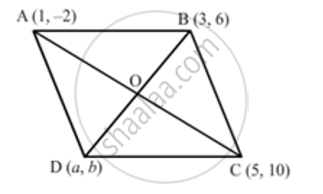
We know that the diagonals of a parallelogram bisect each other Therefore, O is the midpoint of AC as well as BD.
`" Midpoint of AC "=((1+5)/2 , (-2+10)/2) = (6/2,8/2) = (3,4)`
`"Midpoint of BD "= ((3+a)/2 , (6+b)/2)`
Therefore , `(3+a)/2 = 3 and (6+b)/2 = 4`
⇒ 3+a =6 and 6+b=8
⇒ a = 6-3 and b = 8 -6
⇒ a= 3 and b = 2
Therefore, the fourth vertex is D (3,2) .
संबंधित प्रश्न
Show that the points A(5, 6), B(1, 5), C(2, 1) and D(6,2) are the vertices of a square.
In what ratio is the line segment joining (-3, -1) and (-8, -9) divided at the point (-5, -21/5)?
Determine the ratio in which the straight line x - y - 2 = 0 divides the line segment
joining (3, -1) and (8, 9).
Find the ratio in which the line segment joining (-2, -3) and (5, 6) is divided by y-axis. Also, find the coordinates of the point of division in each case.
The points A(2, 0), B(9, 1) C(11, 6) and D(4, 4) are the vertices of a quadrilateral ABCD. Determine whether ABCD is a rhombus or not.
If the points A (a, -11), B (5, b), C (2, 15) and D (1, 1) are the vertices of a parallelogram ABCD, find the values of a and b.
Find the points on the y-axis which is equidistant form the points A(6,5) and B(- 4,3)
Points P, Q, and R in that order are dividing line segment joining A (1,6) and B(5, -2) in four equal parts. Find the coordinates of P, Q and R.
Show that the points (−2, 3), (8, 3) and (6, 7) are the vertices of a right triangle ?
Find the area of the quadrilateral ABCD, whose vertices are A(−3, −1), B (−2, −4), C(4, − 1) and D (3, 4).
Points (−4, 0) and (7, 0) lie
The ordinate of any point on x-axis is
A point whose abscissa is −3 and ordinate 2 lies in
The points \[A \left( x_1 , y_1 \right) , B\left( x_2 , y_2 \right) , C\left( x_3 , y_3 \right)\] are the vertices of ΔABC .
(i) The median from A meets BC at D . Find the coordinates of the point D.
(ii) Find the coordinates of the point P on AD such that AP : PD = 2 : 1.
(iii) Find the points of coordinates Q and R on medians BE and CF respectively such thatBQ : QE = 2 : 1 and CR : RF = 2 : 1.
(iv) What are the coordinates of the centropid of the triangle ABC ?
Write the ratio in which the line segment joining points (2, 3) and (3, −2) is divided by X axis.
The area of the triangle formed by (a, b + c), (b, c + a) and (c, a + b)
The coordinates of the point P dividing the line segment joining the points A (1, 3) and B(4, 6) in the ratio 2 : 1 are
(–1, 7) is a point in the II quadrant.
The distance of the point (–1, 7) from x-axis is ______.
