Advertisements
Advertisements
प्रश्न
Find the area of the quadrilateral ABCD, whose vertices are A(−3, −1), B (−2, −4), C(4, − 1) and D (3, 4).
Advertisements
उत्तर
The given quadrilateral i.e., ABCD whose vertices are A (−3, −1), B (−2, −4), C (4, −1) and D (3, 4) can be drawn as follows:
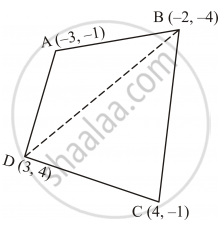
Here, B is joined with D.
We know that the area of a triangle whose vertices are (x1 , y1 ), (x2 , y2 ) and (x3 , y3 ) is given by
`=1/2[x_1(y_2-y_3)+x_2(y_3-y_1)+x_3(y_1-y_2)]`
`=1/2[-3(-8)-2(5)+3(3)]`
`=1/2[24-10+9]`
`=23/2`
`=11.5 sq.inits`
∴ar(ΔABD)
`=1/2[-3(-4-4)+(-2)(4+1)+3(-1+4)]`
∴ar (ΔCDB)
`=1/2[4(4+4)+3(-4+1)+(-2)(-1-4)]`
`=1/2[(4xx8)+(3x-3)-2xx(-5)]`
`=1/2[32-9+10]`
`=33/2`
`=16.5 sp.unit`
Thus, ar (ABCD) = ar (ΔABD) + ar (ΔCDB) = (11.5 + 16.5) sq units = 28 sq units
APPEARS IN
संबंधित प्रश्न
Find the value of x such that PQ = QR where the coordinates of P, Q and R are (6, -1), (1, 3) and (x, 8) respectively.
Name the quadrilateral formed, if any, by the following points, and given reasons for your answers:
A(-1,-2) B(1, 0), C (-1, 2), D(-3, 0)
Three consecutive vertices of a parallelogram are (-2,-1), (1, 0) and (4, 3). Find the fourth vertex.
The line joining the points (2, 1) and (5, −8) is trisected at the points P and Q. If point P lies on the line 2x − y + k = 0. Find the value of k.
Point A lies on the line segment PQ joining P(6, -6) and Q(-4, -1) in such a way that `(PA)/( PQ)=2/5` . If that point A also lies on the line 3x + k( y + 1 ) = 0, find the value of k.
Points (−4, 0) and (7, 0) lie
The area of the triangle formed by the points P (0, 1), Q (0, 5) and R (3, 4) is
If the point P(x, 3) is equidistant from the point A(7, −1) and B(6, 8), then find the value of x and find the distance AP.
If R (x, y) is a point on the line segment joining the points P (a, b) and Q (b, a), then prove that x + y = a + b.
The line 3x + y – 9 = 0 divides the line joining the points (1, 3) and (2, 7) internally in the ratio ______.
