Advertisements
Advertisements
Question
Find the area of the quadrilateral ABCD, whose vertices are A(−3, −1), B (−2, −4), C(4, − 1) and D (3, 4).
Advertisements
Solution
The given quadrilateral i.e., ABCD whose vertices are A (−3, −1), B (−2, −4), C (4, −1) and D (3, 4) can be drawn as follows:
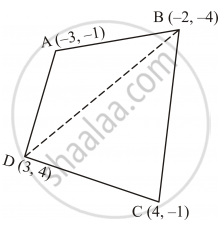
Here, B is joined with D.
We know that the area of a triangle whose vertices are (x1 , y1 ), (x2 , y2 ) and (x3 , y3 ) is given by
`=1/2[x_1(y_2-y_3)+x_2(y_3-y_1)+x_3(y_1-y_2)]`
`=1/2[-3(-8)-2(5)+3(3)]`
`=1/2[24-10+9]`
`=23/2`
`=11.5 sq.inits`
∴ar(ΔABD)
`=1/2[-3(-4-4)+(-2)(4+1)+3(-1+4)]`
∴ar (ΔCDB)
`=1/2[4(4+4)+3(-4+1)+(-2)(-1-4)]`
`=1/2[(4xx8)+(3x-3)-2xx(-5)]`
`=1/2[32-9+10]`
`=33/2`
`=16.5 sp.unit`
Thus, ar (ABCD) = ar (ΔABD) + ar (ΔCDB) = (11.5 + 16.5) sq units = 28 sq units
APPEARS IN
RELATED QUESTIONS
Prove that (4, 3), (6, 4) (5, 6) and (3, 5) are the angular points of a square.
Find the points on the x-axis, each of which is at a distance of 10 units from the point A(11, –8).
ABCD is rectangle formed by the points A(-1, -1), B(-1, 4), C(5, 4) and D(5, -1). If P,Q,R and S be the midpoints of AB, BC, CD and DA respectively, Show that PQRS is a rhombus.
Prove that the diagonals of a rectangle ABCD with vertices A(2,-1), B(5,-1) C(5,6) and D(2,6) are equal and bisect each other
Show that the points (−2, 3), (8, 3) and (6, 7) are the vertices of a right triangle ?
Find the area of a parallelogram ABCD if three of its vertices are A(2, 4), B(2 + \[\sqrt{3}\] , 5) and C(2, 6).
Write the formula for the area of the triangle having its vertices at (x1, y1), (x2, y2) and (x3, y3).
Find the value of a so that the point (3, a) lies on the line represented by 2x − 3y + 5 = 0
Points (1, – 1), (2, – 2), (4, – 5), (– 3, – 4) ______.
Seg AB is parallel to X-axis and coordinates of the point A are (1, 3), then the coordinates of the point B can be ______.
