Advertisements
Advertisements
प्रश्न
Find the area of the quadrilateral ABCD, whose vertices are A(−3, −1), B (−2, −4), C(4, − 1) and D (3, 4).
Advertisements
उत्तर
The given quadrilateral i.e., ABCD whose vertices are A (−3, −1), B (−2, −4), C (4, −1) and D (3, 4) can be drawn as follows:
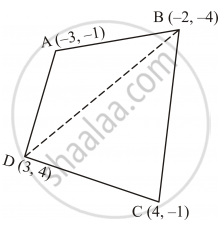
Here, B is joined with D.
We know that the area of a triangle whose vertices are (x1 , y1 ), (x2 , y2 ) and (x3 , y3 ) is given by
`=1/2[x_1(y_2-y_3)+x_2(y_3-y_1)+x_3(y_1-y_2)]`
`=1/2[-3(-8)-2(5)+3(3)]`
`=1/2[24-10+9]`
`=23/2`
`=11.5 sq.inits`
∴ar(ΔABD)
`=1/2[-3(-4-4)+(-2)(4+1)+3(-1+4)]`
∴ar (ΔCDB)
`=1/2[4(4+4)+3(-4+1)+(-2)(-1-4)]`
`=1/2[(4xx8)+(3x-3)-2xx(-5)]`
`=1/2[32-9+10]`
`=33/2`
`=16.5 sp.unit`
Thus, ar (ABCD) = ar (ΔABD) + ar (ΔCDB) = (11.5 + 16.5) sq units = 28 sq units
APPEARS IN
संबंधित प्रश्न
Let ABCD be a square of side 2a. Find the coordinates of the vertices of this square when The centre of the square is at the origin and coordinate axes are parallel to the sides AB and AD respectively.
Prove that the points (3, 0), (4, 5), (-1, 4) and (-2, -1), taken in order, form a rhombus.
Also, find its area.
Find a point on y-axis which is equidistant from the points (5, -2) and (-3, 2).
In what ratio is the line segment joining (-3, -1) and (-8, -9) divided at the point (-5, -21/5)?
Find the ratio in which the line segment joining (-2, -3) and (5, 6) is divided by x-axis Also, find the coordinates of the point of division in each case.
Mark the correct alternative in each of the following:
The point of intersect of the coordinate axes is
Points (−4, 0) and (7, 0) lie
Write the distance between the points A (10 cos θ, 0) and B (0, 10 sin θ).
Write the formula for the area of the triangle having its vertices at (x1, y1), (x2, y2) and (x3, y3).
Abscissa of all the points on the x-axis is ______.
