Advertisements
Advertisements
प्रश्न
If three consecutive vertices of a parallelogram are (1, -2), (3, 6) and (5, 10), find its fourth vertex.
If three consecutive vertices of a parallelogram ABCD are A (1,-2) , B (3,6) and C(5,10) find its fourth vertex D.
Advertisements
उत्तर १
Let ABCD be a parallelogram in which the coordinates of the vertices are A (1,−2);
B (3, 6) and C(5, 10). We have to find the coordinates of the fourth vertex.
Let the fourth vertex be D(x,y)
Since ABCD is a parallelogram, the diagonals bisect each other. Therefore the mid-point of the diagonals of the parallelogram will coincide.
Now to find the mid-point P(x,y) of two points `A(x_1, y_1)` and `B(x_2,y_1)` we use section formula as,
`P(x,y) = ((x_1 + x_2)/2,(y_1+ y_2)/2)`
The mid-point of the diagonals of the parallelogram will coincide.
So,
Co-oridinate of mid-point of AC = Co-ordinate of mid-point of BD
Therefore,
`((5+1)/2, (10-2)/2) = ((x+3)/2, (y + 6)/2)`
`((x + 3)/2 ,(y + 6)/2) = (3,4)`
Now equate the individual terms to get the unknown value. So,
`(x + 3)/2= 3`
Similarly
`(y + 6)/2 = 4`
y = 2
So the forth vertex is D(3,2)
उत्तर २
LetA (1,-2) , B (3,6) and C(5,10) be the three vertices of a parallelogram ABCD and the fourth vertex be D (a, b).
Join AC and BD intersecting at O.
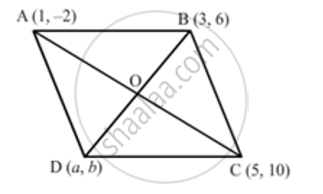
We know that the diagonals of a parallelogram bisect each other Therefore, O is the midpoint of AC as well as BD.
`" Midpoint of AC "=((1+5)/2 , (-2+10)/2) = (6/2,8/2) = (3,4)`
`"Midpoint of BD "= ((3+a)/2 , (6+b)/2)`
Therefore , `(3+a)/2 = 3 and (6+b)/2 = 4`
⇒ 3+a =6 and 6+b=8
⇒ a = 6-3 and b = 8 -6
⇒ a= 3 and b = 2
Therefore, the fourth vertex is D (3,2) .
संबंधित प्रश्न
(Street Plan): A city has two main roads which cross each other at the centre of the city. These two roads are along the North-South direction and East-West direction.
All the other streets of the city run parallel to these roads and are 200 m apart. There are 5 streets in each direction. Using 1cm = 200 m, draw a model of the city on your notebook. Represent the roads/streets by single lines.
There are many cross- streets in your model. A particular cross-street is made by two streets, one running in the North - South direction and another in the East - West direction. Each cross street is referred to in the following manner : If the 2nd street running in the North - South direction and 5th in the East - West direction meet at some crossing, then we will call this cross-street (2, 5). Using this convention, find:
- how many cross - streets can be referred to as (4, 3).
- how many cross - streets can be referred to as (3, 4).
Find the centre of the circle passing through (5, -8), (2, -9) and (2, 1).
Find the coordinates of the circumcentre of the triangle whose vertices are (3, 0), (-1, -6) and (4, -1). Also, find its circumradius.
Show that the points A(5, 6), B(1, 5), C(2, 1) and D(6,2) are the vertices of a square.
The points A(2, 0), B(9, 1) C(11, 6) and D(4, 4) are the vertices of a quadrilateral ABCD. Determine whether ABCD is a rhombus or not.
Find the points on the x-axis, each of which is at a distance of 10 units from the point A(11, –8).
Show that the points A(2,1), B(5,2), C(6,4) and D(3,3) are the angular points of a parallelogram. Is this figure a rectangle?
If the point `P (1/2,y)` lies on the line segment joining the points A(3, –5) and B(–7, 9) then find the ratio in which P divides AB. Also, find the value of y.
Find the coordinates of the points of trisection of the line segment joining the points (3, –2) and (–3, –4) ?
Find the ratio in which the point (−3, k) divides the line-segment joining the points (−5, −4) and (−2, 3). Also find the value of k ?
If (0, −3) and (0, 3) are the two vertices of an equilateral triangle, find the coordinates of its third vertex.
If three points (x1, y1) (x2, y2), (x3, y3) lie on the same line, prove that \[\frac{y_2 - y_3}{x_2 x_3} + \frac{y_3 - y_1}{x_3 x_1} + \frac{y_1 - y_2}{x_1 x_2} = 0\]
Find the value(s) of k for which the points (3k − 1, k − 2), (k, k − 7) and (k − 1, −k − 2) are collinear.
Find the distance between the points \[\left( - \frac{8}{5}, 2 \right)\] and \[\left( \frac{2}{5}, 2 \right)\] .
The line segment joining points (−3, −4), and (1, −2) is divided by y-axis in the ratio.
The ratio in which (4, 5) divides the join of (2, 3) and (7, 8) is

In the above figure, seg PA, seg QB and RC are perpendicular to seg AC. From the information given in the figure, prove that: `1/x + 1/y = 1/z`
Students of a school are standing in rows and columns in their playground for a drill practice. A, B, C and D are the positions of four students as shown in figure. Is it possible to place Jaspal in the drill in such a way that he is equidistant from each of the four students A, B, C and D? If so, what should be his position?
The distance of the point (3, 5) from x-axis (in units) is ______.
