हिंदी

If A(4, 9), B(2, 3) and C(6, 5) are the vertices of ∆ABC, then the length of median through C is - Mathematics

Advertisements
Advertisements

प्रश्न

If A(4, 9), B(2, 3) and C(6, 5) are the vertices of ∆ABC, then the length of median through C is

विकल्प

  • 5 units  

  • \[\sqrt{10}\] units                      


  • 25 units   

  •  10 units  

MCQ
Advertisements

उत्तर

It is given that A(4, 9), B(2, 3) and C(6, 5) are the vertices of ∆ABC. 
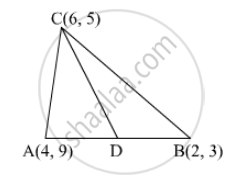
Let CD be the median of ∆ABC through C. Then, D is the mid-point of AB.

Using mid-point formula, we get

Coordinates of D = \[\left( \frac{4 + 2}{2}, \frac{9 + 3}{2} \right) = \left( \frac{6}{2}, \frac{12}{2} \right) = \left( 3, 6 \right)\]

∴ Length of the median, AD 

\[= \sqrt{\left( 6 - 3 \right)^2 + \left( 5 - 6 \right)^2} \left( \text{ Using distance formula } \right)\]
\[ = \sqrt{3^2 + \left( - 1 \right)^2}\]
\[ = \sqrt{10} \text{ units } \]

Thus, the length of the required median is \[\sqrt{10}\] units.


shaalaa.com
  क्या इस प्रश्न या उत्तर में कोई त्रुटि है?
अध्याय 6: Co-Ordinate Geometry - Exercise 6.7 [पृष्ठ ६६]

APPEARS IN

आरडी शर्मा Mathematics [English] Class 10
अध्याय 6 Co-Ordinate Geometry
Exercise 6.7 | Q 45 | पृष्ठ ६६

वीडियो ट्यूटोरियलVIEW ALL [2]

संबंधित प्रश्न

How will you describe the position of a table lamp on your study table to another person?


If A and B are (1, 4) and (5, 2) respectively, find the coordinates of P when AP/BP = 3/4.


If the point C ( - 2,3)  is equidistant form the points A (3, -1) and Bx (x ,8)  , find the value of x. Also, find the distance between BC


Show that the points A(3,0), B(4,5), C(-1,4) and D(-2,-1) are the vertices of a rhombus. Find its area.


Find the co-ordinates of the point which divides the join of A(-5, 11) and B(4,-7) in the ratio 7 : 2


In what ratio does y-axis divide the line segment joining the points (-4, 7) and (3, -7)?


Find the ratio which the line segment joining the pints A(3, -3) and B(-2,7) is divided by x -axis Also, find the point of division.


Find the area of quadrilateral PQRS whose vertices are P(-5, -3), Q(-4,-6),R(2, -3) and S(1,2).


Find the point on x-axis which is equidistant from points A(-1,0) and B(5,0)


If A (1, 2) B (4, 3) and C (6, 6) are the three vertices of a parallelogram ABCD, find the coordinates of fourth vertex D.


What is the distance between the points  \[A\left( \sin\theta - \cos\theta, 0 \right)\] and \[B\left( 0, \sin\theta + \cos\theta \right)\] ?


If three points (0, 0), \[\left( 3, \sqrt{3} \right)\]  and (3, λ) form an equilateral triangle, then λ =


If A (5, 3), B (11, −5) and P (12, y) are the vertices of a right triangle right angled at P, then y=


In the above figure, seg PA, seg QB and RC are perpendicular to seg AC. From the information given in the figure, prove that: `1/x + 1/y = 1/z`


Signs of the abscissa and ordinate of a point in the second quadrant are respectively.


Abscissa of a point is positive in ______.


Point (3, 0) lies in the first quadrant.


In which ratio the y-axis divides the line segment joining the points (5, – 6) and (–1, – 4)?


Share
Notifications

Englishहिंदीमराठी


      Forgot password?
Use app×