Advertisements
Advertisements
प्रश्न
In \[∆\] ABC , the coordinates of vertex A are (0, - 1) and D (1,0) and E(0,10) respectively the mid-points of the sides AB and AC . If F is the mid-points of the side BC , find the area of \[∆\] DEF.
Advertisements
उत्तर
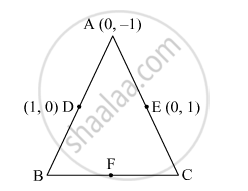
Let the coordinates of B and C be \[\left( x_2 , y_2 \right)\] and \[\left( x_3 , y_3 \right)\] , respectively.
D is the midpoint of AB.
So,
\[\left( 1, 0 \right) = \left( \frac{x_2 + 0}{2}, \frac{y_2 - 1}{2} \right)\]
\[ \Rightarrow 1 = \frac{x_2}{2} \text { and } 0 = \frac{y_2 - 1}{2}\]
\[ \Rightarrow x_2 = 2 \text{ and } y_2 = 1\]
Thus, the coordinates of B are (2, 1).
Similarly, E is the midpoint of AC.
So,
\[\left( 0, 1 \right) = \left( \frac{x_3 + 0}{2}, \frac{y_3 - 1}{2} \right)\]
\[ \Rightarrow 0 = \frac{x_3}{2} \text{ and } 1 = \frac{y_3 - 1}{2}\]
\[ \Rightarrow x_3 = 0 \text{ and } y_3 = 3\]
Thus, the coordinates of C are (0, 3).
Also, F is the midpoint of BC. So, its coordinates are \[\left( \frac{2 + 0}{2}, \frac{1 + 3}{2} \right) = \left( 1, 2 \right)\]
\[\frac{1}{2}\left[ 0\left( 1 - 3 \right) + 2\left( 3 + 1 \right) + 0\left( - 1 - 1 \right) \right]\]
\[ = \frac{1}{2} \times 8\]
\[ = 4 \text{ square units } \]
And the area of \[∆\] DEF is
\[\frac{1}{2}\left[ 1\left( 1 - 2 \right) + 0\left( 2 - 0 \right) + 1\left( 0 - 1 \right) \right]\]
\[ = \frac{1}{2} \times \left( - 2 \right)\]
\[ = 1 \text{ square unit } \left( \text{ Taking the numerical value, as the area cannot be negative } \right)\]
APPEARS IN
संबंधित प्रश्न
Let ABCD be a square of side 2a. Find the coordinates of the vertices of this square when A coincides with the origin and AB and AD are along OX and OY respectively.
If two opposite vertices of a square are (5, 4) and (1, −6), find the coordinates of its remaining two vertices.
Name the quadrilateral formed, if any, by the following points, and given reasons for your answers:
A(4, 5) B(7, 6), C (4, 3), D(1, 2)
Prove that the points (3, -2), (4, 0), (6, -3) and (5, -5) are the vertices of a parallelogram.
Prove that the points (4, 5) (7, 6), (6, 3) (3, 2) are the vertices of a parallelogram. Is it a rectangle.
Show hat A(1,2), B(4,3),C(6,6) and D(3,5) are the vertices of a parallelogram. Show that ABCD is not rectangle.
Find the co-ordinates of the point which divides the join of A(-5, 11) and B(4,-7) in the ratio 7 : 2
In what ratio does the point P(2,5) divide the join of A (8,2) and B(-6, 9)?
In what ratio is the line segment joining the points A(-2, -3) and B(3,7) divided by the yaxis? Also, find the coordinates of the point of division.
The base BC of an equilateral triangle ABC lies on y-axis. The coordinates of point C are (0, −3). The origin is the midpoint of the base. Find the coordinates of the points A and B. Also, find the coordinates of another point D such that ABCD is a rhombus.
Find the ratio in which the point (-1, y) lying on the line segment joining points A(-3, 10) and (6, -8) divides it. Also, find the value of y.
If the point A(0,2) is equidistant from the points B(3,p) and C(p, 5), find p.
Find the area of the quadrilateral ABCD, whose vertices are A(−3, −1), B (−2, −4), C(4, − 1) and D (3, 4).
If the point P (m, 3) lies on the line segment joining the points \[A\left( - \frac{2}{5}, 6 \right)\] and B (2, 8), find the value of m.
A line segment is of length 10 units. If the coordinates of its one end are (2, −3) and the abscissa of the other end is 10, then its ordinate is
If the area of the triangle formed by the points (x, 2x), (−2, 6) and (3, 1) is 5 square units , then x =
The line segment joining points (−3, −4), and (1, −2) is divided by y-axis in the ratio.
If the line segment joining the points (3, −4), and (1, 2) is trisected at points P (a, −2) and Q \[\left( \frac{5}{3}, b \right)\] , Then,
What is the nature of the line which includes the points (-5, 5), (6, 5), (-3, 5), (0, 5)?
Point (3, 0) lies in the first quadrant.
