Advertisements
Advertisements
प्रश्न
If the points P (a,-11) , Q (5,b) ,R (2,15) and S (1,1). are the vertices of a parallelogram PQRS, find the values of a and b.
Advertisements
उत्तर
The points are P (a,-11),Q(5,b) , R (2,15) and S(1,1).
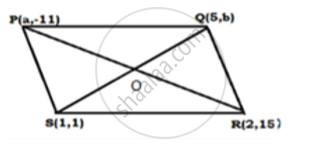
Join PR and QS, intersecting at O.
We know that the diagonals of a parallelogram bisect each other Therefore, O is the midpoint of PR as well as QS.
`"Midpoint of PR" = ((a+2)/2,(-11+15)/2) = ((a+2)/2,4/2) = ((a+2)/2,2)`
`"Midpoint of QS " = ((5+1)/2 , (b+1)/2) = (6/2 ,(b+1)/2) = (3,(b+1)/2)`
Therefore , `(a+2)/2 =3, (b+1)/2= 2`
⇒ a +2 = 6, b+1=4
⇒ a = 6 - 2, b = 4-1
⇒ a = 4 and b= 3
APPEARS IN
संबंधित प्रश्न
Prove that the points (3, 0), (6, 4) and (-1, 3) are the vertices of a right-angled isosceles triangle.
Name the quadrilateral formed, if any, by the following points, and given reasons for your answers:
A(-1,-2) B(1, 0), C (-1, 2), D(-3, 0)
Prove that the points A(-4,-1), B(-2, 4), C(4, 0) and D(2, 3) are the vertices of a rectangle.
If the points p (x, y) is point equidistant from the points A (5, 1)and B (–1, 5), Prove that 3x = 2y
If the point ( x,y ) is equidistant form the points ( a+b,b-a ) and (a-b ,a+b ) , prove that bx = ay
Show that the following points are the vertices of a square:
(i) A (3,2), B(0,5), C(-3,2) and D(0,-1)
Find the coordinates of the centre of the circle passing through the points P(6, –6), Q(3, –7) and R (3, 3).
If R (x, y) is a point on the line segment joining the points P (a, b) and Q (b, a), then prove that x + y = a + b.
If the points A(1, –2), B(2, 3) C(a, 2) and D(– 4, –3) form a parallelogram, find the value of a and height of the parallelogram taking AB as base.
What is the area of the triangle formed by the points O (0, 0), A (6, 0) and B (0, 4)?
The distance between the points (a cos θ + b sin θ, 0) and (0, a sin θ − b cos θ) is
If (−1, 2), (2, −1) and (3, 1) are any three vertices of a parallelogram, then
The area of the triangle formed by (a, b + c), (b, c + a) and (c, a + b)
If the line segment joining the points (3, −4), and (1, 2) is trisected at points P (a, −2) and Q \[\left( \frac{5}{3}, b \right)\] , Then,
What is the form of co-ordinates of a point on the X-axis?
Find the coordinates of point A, where AB is a diameter of the circle with centre (–2, 2) and B is the point with coordinates (3, 4).
Which of the points P(0, 3), Q(1, 0), R(0, –1), S(–5, 0), T(1, 2) do not lie on the x-axis?
Seg AB is parallel to X-axis and coordinates of the point A are (1, 3), then the coordinates of the point B can be ______.
Co-ordinates of origin are ______.
The distance of the point (–6, 8) from x-axis is ______.
