Advertisements
Advertisements
Question
If the points P (a,-11) , Q (5,b) ,R (2,15) and S (1,1). are the vertices of a parallelogram PQRS, find the values of a and b.
Advertisements
Solution
The points are P (a,-11),Q(5,b) , R (2,15) and S(1,1).
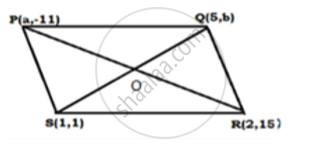
Join PR and QS, intersecting at O.
We know that the diagonals of a parallelogram bisect each other Therefore, O is the midpoint of PR as well as QS.
`"Midpoint of PR" = ((a+2)/2,(-11+15)/2) = ((a+2)/2,4/2) = ((a+2)/2,2)`
`"Midpoint of QS " = ((5+1)/2 , (b+1)/2) = (6/2 ,(b+1)/2) = (3,(b+1)/2)`
Therefore , `(a+2)/2 =3, (b+1)/2= 2`
⇒ a +2 = 6, b+1=4
⇒ a = 6 - 2, b = 4-1
⇒ a = 4 and b= 3
APPEARS IN
RELATED QUESTIONS
How will you describe the position of a table lamp on your study table to another person?
The three vertices of a parallelogram are (3, 4) (3, 8) and (9, 8). Find the fourth vertex.
Determine the ratio in which the point (-6, a) divides the join of A (-3, 1) and B (-8, 9). Also, find the value of a.
If p(x , y) is point equidistant from the points A(6, -1) and B(2,3) A , show that x – y = 3
Find the coordinates of the midpoints of the line segment joining
P(-11,-8) and Q(8,-2)
The line segment joining A( 2,9) and B(6,3) is a diameter of a circle with center C. Find the coordinates of C
`"Find the ratio in which the poin "p (3/4 , 5/12) " divides the line segment joining the points "A (1/2,3/2) and B (2,-5).`
In what ratio does the line x - y - 2 = 0 divide the line segment joining the points A (3, 1) and B (8, 9)?
Find the ratio in which the point (-1, y) lying on the line segment joining points A(-3, 10) and (6, -8) divides it. Also, find the value of y.
Find the area of quadrilateral ABCD whose vertices are A(-5, 7), B(-4, -5) C(-1,-6) and D(4,5)
The co-ordinates of point A and B are 4 and -8 respectively. Find d(A, B).
The abscissa of a point is positive in the
Show that ΔABC, where A(–2, 0), B(2, 0), C(0, 2) and ΔPQR where P(–4, 0), Q(4, 0), R(0, 2) are similar triangles.
If (x, y) be on the line joining the two points (1, −3) and (−4, 2) , prove that x + y + 2= 0.
If R (x, y) is a point on the line segment joining the points P (a, b) and Q (b, a), then prove that x + y = a + b.
Find the values of x for which the distance between the point P(2, −3), and Q (x, 5) is 10.
Find the area of triangle with vertices ( a, b+c) , (b, c+a) and (c, a+b).
Which of the points P(-1, 1), Q(3, - 4), R(1, -1), S (-2, -3), T(-4, 4) lie in the fourth quadrant?
Find the coordinates of the point of intersection of the graph of the equation x = 2 and y = –3.
If the points P(1, 2), Q(0, 0) and R(x, y) are collinear, then find the relation between x and y.
Given points are P(1, 2), Q(0, 0) and R(x, y).
The given points are collinear, so the area of the triangle formed by them is `square`.
∴ `1/2 |x_1(y_2 - y_3) + x_2(y_3 - y_1) + x_3(y_1 - y_2)| = square`
`1/2 |1(square) + 0(square) + x(square)| = square`
`square + square + square` = 0
`square + square` = 0
`square = square`
Hence, the relation between x and y is `square`.
