Advertisements
Advertisements
Question
The three vertices of a parallelogram are (3, 4) (3, 8) and (9, 8). Find the fourth vertex.
Advertisements
Solution
Let A(3,4), B(3,8) and C(9,8) be the three given vertex then the fourth vertex D(x,y)
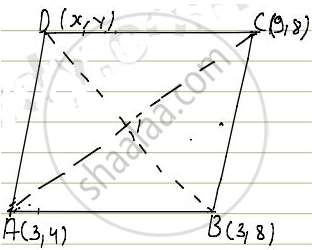
Since ABCD is a parallelogram, the diagonals bisect each other.
Therefore the mid-point of diagonals of the parallelogram coincide.
Let p(x,y) be the mid-point of diagonals AC then,
`P(x,y) = ((3 + 9)/2, (4 + 8)/2)`
P(x,y) = (6,6)
Let Q(x,y) be the mid point of diagonal BD. then
`Q(x,y) = ((3 + x)/2, (8 + y)/2)`
Coordinates of mid-point AC = Coordinates of mid-point BD
P(x,y) = Q(x,y)
`=> (6,6) = ((3 + x)/2, (8 + y)/2)`
Now equating individual components
`=> 6 = (3 + x)/2` and `6 = (8 + 4)/2`
=> 3 + x = 12 and 8 + y = 12
=> x = 9 and y = 4
Hence, coordinates of fourth points are (9, 4)
APPEARS IN
RELATED QUESTIONS
Find a point on y-axis which is equidistant from the points (5, -2) and (-3, 2).
Find the points of trisection of the line segment joining the points:
5, −6 and (−7, 5),
Find the points of trisection of the line segment joining the points:
(2, -2) and (-7, 4).
Prove that the points (4, 5) (7, 6), (6, 3) (3, 2) are the vertices of a parallelogram. Is it a rectangle.
The line segment joining the points P(3, 3) and Q(6, -6) is trisected at the points A and B such that Ais nearer to P. If A also lies on the line given by 2x + y + k = 0, find the value of k.
If the coordinates of the mid-points of the sides of a triangle be (3, -2), (-3, 1) and (4, -3), then find the coordinates of its vertices.
If (2, p) is the midpoint of the line segment joining the points A(6, -5) and B(-2,11) find the value of p.
Find the ratio in which the pint (-3, k) divide the join of A(-5, -4) and B(-2, 3),Also, find the value of k.
Find the possible pairs of coordinates of the fourth vertex D of the parallelogram, if three of its vertices are A(5, 6), B(1, –2) and C(3, –2).
Mark the correct alternative in each of the following:
The point of intersect of the coordinate axes is
If A(−3, 5), B(−2, −7), C(1, −8) and D(6, 3) are the vertices of a quadrilateral ABCD, find its area.
Write the coordinates of a point on X-axis which is equidistant from the points (−3, 4) and (2, 5).
The distance between the points (a cos 25°, 0) and (0, a cos 65°) is
If x is a positive integer such that the distance between points P (x, 2) and Q (3, −6) is 10 units, then x =
If three points (0, 0), \[\left( 3, \sqrt{3} \right)\] and (3, λ) form an equilateral triangle, then λ =
If the points(x, 4) lies on a circle whose centre is at the origin and radius is 5, then x =
If points A (5, p) B (1, 5), C (2, 1) and D (6, 2) form a square ABCD, then p =
If the line segment joining the points (3, −4), and (1, 2) is trisected at points P (a, −2) and Q \[\left( \frac{5}{3}, b \right)\] , Then,
If A(x, 2), B(−3, −4) and C(7, −5) are collinear, then the value of x is
The coordinates of a point whose ordinate is `-1/2` and abscissa is 1 are `-1/2, 1`.
