Advertisements
Advertisements
Question
If the point P (2,2) is equidistant from the points A ( -2,K ) and B( -2K , -3) , find k. Also, find the length of AP.
Advertisements
Solution
As per the question, we have
AP = BP
`⇒sqrt((2+2)^2 +(2+k)^2) = sqrt(( 2+2k)^2 +(2+3)^2)`
`⇒sqrt((4)^2 +(2-k)^2) = sqrt((2+2k)^2 + (5)^2)`
⇒ 16+ 4 +k2 - 4k = 4+ 4k2 + 8k +25 (Squaring both sides)
`⇒k^2 + 4k +3=0`
⇒ (k+1) (k+3) =0
⇒ k =-3, -1
Now for k = -1
`AP= sqrt ((2+2)^2 +(2-k)^2)`
`= sqrt((4)^2 +(2+1)^2)`
`= sqrt(16+9) = 5` units
For k = -3
`AP= sqrt(( 2+2)^2 +(2-k)^2)`
`= sqrt((4)^2+(2+3)^2)`
`=sqrt(16+25) = sqrt(41)` units
Hence, k= -1,-3; AP= 5 units for k=-1 and AP=`sqrt(41)` units for k=-3.
APPEARS IN
RELATED QUESTIONS
On which axis do the following points lie?
P(5, 0)
Find the distance between the following pair of points:
(a, 0) and (0, b)
In Fig. 14.36, a right triangle BOA is given C is the mid-point of the hypotenuse AB. Show that it is equidistant from the vertices O, A and B.
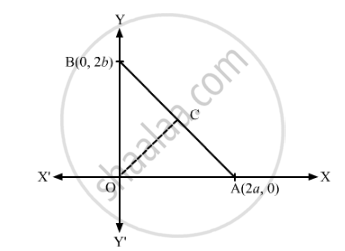
We have a right angled triangle,`triangle BOA` right angled at O. Co-ordinates are B (0,2b); A (2a, 0) and C (0, 0).
Find the points of trisection of the line segment joining the points:
5, −6 and (−7, 5),
In what ratio is the line segment joining the points (-2,-3) and (3, 7) divided by the y-axis? Also, find the coordinates of the point of division.
The line joining the points (2, 1) and (5, −8) is trisected at the points P and Q. If point P lies on the line 2x − y + k = 0. Find the value of k.
If the poin A(0,2) is equidistant form the points B (3, p) and C (p ,5) find the value of p. Also, find the length of AB.
Points P, Q, R and S divide the line segment joining the points A(1,2) and B(6,7) in five equal parts. Find the coordinates of the points P,Q and R
The line segment joining A( 2,9) and B(6,3) is a diameter of a circle with center C. Find the coordinates of C
Find the possible pairs of coordinates of the fourth vertex D of the parallelogram, if three of its vertices are A(5, 6), B(1, –2) and C(3, –2).
A point whose abscissa is −3 and ordinate 2 lies in
The perpendicular distance of the P (4,3) from y-axis is
If A(3, y) is equidistant from points P(8, −3) and Q(7, 6), find the value of y and find the distance AQ.
The points \[A \left( x_1 , y_1 \right) , B\left( x_2 , y_2 \right) , C\left( x_3 , y_3 \right)\] are the vertices of ΔABC .
(i) The median from A meets BC at D . Find the coordinates of the point D.
(ii) Find the coordinates of the point P on AD such that AP : PD = 2 : 1.
(iii) Find the points of coordinates Q and R on medians BE and CF respectively such thatBQ : QE = 2 : 1 and CR : RF = 2 : 1.
(iv) What are the coordinates of the centropid of the triangle ABC ?
The line segment joining points (−3, −4), and (1, −2) is divided by y-axis in the ratio.
If A(x, 2), B(−3, −4) and C(7, −5) are collinear, then the value of x is
If point P is midpoint of segment joining point A(–4, 2) and point B(6, 2), then the coordinates of P are ______.
If the sum of X-coordinates of the vertices of a triangle is 12 and the sum of Y-coordinates is 9, then the coordinates of centroid are ______.
If the coordinate of point A on the number line is –1 and that of point B is 6, then find d(A, B).
The distance of the point (–4, 3) from y-axis is ______.
