Advertisements
Advertisements
प्रश्न
The three vertices of a parallelogram are (3, 4) (3, 8) and (9, 8). Find the fourth vertex.
Advertisements
उत्तर
Let A(3,4), B(3,8) and C(9,8) be the three given vertex then the fourth vertex D(x,y)
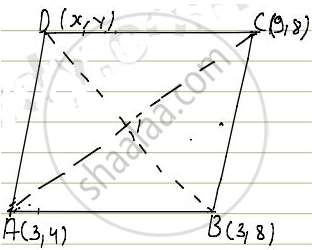
Since ABCD is a parallelogram, the diagonals bisect each other.
Therefore the mid-point of diagonals of the parallelogram coincide.
Let p(x,y) be the mid-point of diagonals AC then,
`P(x,y) = ((3 + 9)/2, (4 + 8)/2)`
P(x,y) = (6,6)
Let Q(x,y) be the mid point of diagonal BD. then
`Q(x,y) = ((3 + x)/2, (8 + y)/2)`
Coordinates of mid-point AC = Coordinates of mid-point BD
P(x,y) = Q(x,y)
`=> (6,6) = ((3 + x)/2, (8 + y)/2)`
Now equating individual components
`=> 6 = (3 + x)/2` and `6 = (8 + 4)/2`
=> 3 + x = 12 and 8 + y = 12
=> x = 9 and y = 4
Hence, coordinates of fourth points are (9, 4)
APPEARS IN
संबंधित प्रश्न
Prove that the points (3, 0), (6, 4) and (-1, 3) are the vertices of a right-angled isosceles triangle.
Find the coordinates of the point where the diagonals of the parallelogram formed by joining the points (-2, -1), (1, 0), (4, 3) and(1, 2) meet
Prove that the points A(-4,-1), B(-2, 4), C(4, 0) and D(2, 3) are the vertices of a rectangle.
The points A(2, 0), B(9, 1) C(11, 6) and D(4, 4) are the vertices of a quadrilateral ABCD. Determine whether ABCD is a rhombus or not.
If the point C ( - 2,3) is equidistant form the points A (3, -1) and Bx (x ,8) , find the value of x. Also, find the distance between BC
Show that the points A(6,1), B(8,2), C(9,4) and D(7,3) are the vertices of a rhombus. Find its area.
The base QR of a n equilateral triangle PQR lies on x-axis. The coordinates of the point Q are (-4, 0) and origin is the midpoint of the base. Find the coordinates of the points P and R.
Show that the points (−2, 3), (8, 3) and (6, 7) are the vertices of a right triangle ?
The perpendicular distance of the P (4,3) from y-axis is
Show that the points (−4, −1), (−2, −4) (4, 0) and (2, 3) are the vertices points of a rectangle.
Show that A (−3, 2), B (−5, −5), C (2,−3), and D (4, 4) are the vertices of a rhombus.
Find the value of k, if the points A (8, 1) B(3, −4) and C(2, k) are collinear.
Write the ratio in which the line segment joining points (2, 3) and (3, −2) is divided by X axis.
Write the coordinates of a point on X-axis which is equidistant from the points (−3, 4) and (2, 5).
If P (2, 6) is the mid-point of the line segment joining A(6, 5) and B(4, y), find y.
The area of the triangle formed by (a, b + c), (b, c + a) and (c, a + b)
If points (a, 0), (0, b) and (1, 1) are collinear, then \[\frac{1}{a} + \frac{1}{b} =\]
The point on the x-axis which is equidistant from points (−1, 0) and (5, 0) is
If A(4, 9), B(2, 3) and C(6, 5) are the vertices of ∆ABC, then the length of median through C is
