Advertisements
Advertisements
Question
The area of the triangle formed by the points P (0, 1), Q (0, 5) and R (3, 4) is
Options
16 sq. units
8 sq. units
4 sq. units
6 sq. units
Advertisements
Solution
Given that the points P (0, 1), Q (0, 5) and R (3, 4) is form a triangle.
We are asked to find the area of the triangle ΔPQR which is shown in the figure.
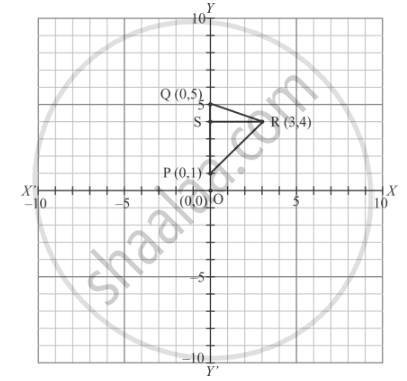
Given that
OP = 1
and OQ = 5
Hence
`PQ = OQ - OP`
= 5-1
= 4
and RS = 3
By using formula,
`"PQR "= 1/2 xx "PQ "xx "RS"`
` = 1/2 xx 4 xx 3`
` = 2 xx 3`
` =6 " sq . units" `
APPEARS IN
RELATED QUESTIONS
Show that the points A(–3, 2), B(–5, –5), C(2, –3) and D(4, 4) are the vertices of a rhombus. Find the area of this rhombus.
HINT: Area of a rhombus = `1/2` × (product of its diagonals).
Find the ratio in which the line segment joining (-2, -3) and (5, 6) is divided by y-axis. Also, find the coordinates of the point of division in each case.
The measure of the angle between the coordinate axes is
A point whose abscissa is −3 and ordinate 2 lies in
If (a,b) is the mid-point of the line segment joining the points A (10, - 6) , B (k,4) and a - 2b = 18 , find the value of k and the distance AB.
Find the value of a for which the area of the triangle formed by the points A(a, 2a), B(−2, 6) and C(3, 1) is 10 square units.
If \[D\left( - \frac{1}{5}, \frac{5}{2} \right), E(7, 3) \text{ and } F\left( \frac{7}{2}, \frac{7}{2} \right)\] are the mid-points of sides of \[∆ ABC\] , find the area of \[∆ ABC\] .
Any point on the line y = x is of the form ______.
In which quadrant, does the abscissa, and ordinate of a point have the same sign?
Assertion (A): The ratio in which the line segment joining (2, -3) and (5, 6) internally divided by x-axis is 1:2.
Reason (R): as formula for the internal division is `((mx_2 + nx_1)/(m + n) , (my_2 + ny_1)/(m + n))`
