Advertisements
Advertisements
प्रश्न
The area of the triangle formed by the points P (0, 1), Q (0, 5) and R (3, 4) is
विकल्प
16 sq. units
8 sq. units
4 sq. units
6 sq. units
Advertisements
उत्तर
Given that the points P (0, 1), Q (0, 5) and R (3, 4) is form a triangle.
We are asked to find the area of the triangle ΔPQR which is shown in the figure.
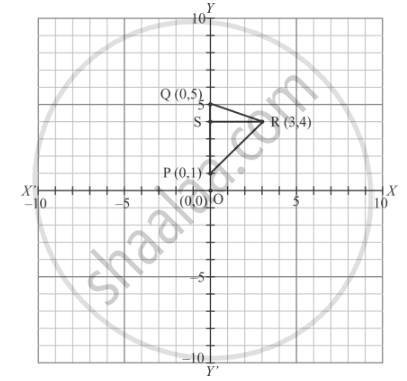
Given that
OP = 1
and OQ = 5
Hence
`PQ = OQ - OP`
= 5-1
= 4
and RS = 3
By using formula,
`"PQR "= 1/2 xx "PQ "xx "RS"`
` = 1/2 xx 4 xx 3`
` = 2 xx 3`
` =6 " sq . units" `
APPEARS IN
संबंधित प्रश्न
Find the equation of the perpendicular bisector of the line segment joining points (7, 1) and (3,5).
Find the points on the x-axis, each of which is at a distance of 10 units from the point A(11, –8).
Show that the following points are the vertices of a square:
(i) A (3,2), B(0,5), C(-3,2) and D(0,-1)
Find the area of quadrilateral ABCD whose vertices are A(-5, 7), B(-4, -5) C(-1,-6) and D(4,5)
A point whose abscissa is −3 and ordinate 2 lies in
Points P, Q, R and S divides the line segment joining A(1, 2) and B(6, 7) in 5 equal parts. Find the coordinates of the points P, Q and R.
If the point P (m, 3) lies on the line segment joining the points \[A\left( - \frac{2}{5}, 6 \right)\] and B (2, 8), find the value of m.
If points Q and reflections of point P (−3, 4) in X and Y axes respectively, what is QR?
Find the value of a so that the point (3, a) lies on the line represented by 2x − 3y + 5 = 0
A tiling or tessellation of a flat surface is the covering of a plane using one or more geometric shapes, called tiles, with no overlaps and no gaps. Historically, tessellations were used in ancient Rome and in Islamic art. You may find tessellation patterns on floors, walls, paintings etc. Shown below is a tiled floor in the archaeological Museum of Seville, made using squares, triangles and hexagons.

A craftsman thought of making a floor pattern after being inspired by the above design. To ensure accuracy in his work, he made the pattern on the Cartesian plane. He used regular octagons, squares and triangles for his floor tessellation pattern

Use the above figure to answer the questions that follow:
- What is the length of the line segment joining points B and F?
- The centre ‘Z’ of the figure will be the point of intersection of the diagonals of quadrilateral WXOP. Then what are the coordinates of Z?
- What are the coordinates of the point on y-axis equidistant from A and G?
OR
What is the area of Trapezium AFGH?
