Advertisements
Advertisements
Question
\[A\left( 6, 1 \right) , B(8, 2) \text{ and } C(9, 4)\] are three vertices of a parallelogram ABCD . If E is the mid-point of DC , find the area of \[∆\] ADE.
Advertisements
Solution
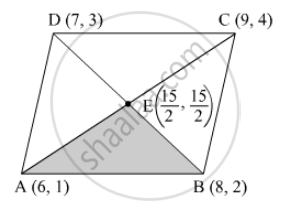
Three vertices are given, then D can be calulated and it comes out to be (7, 3).
Since, E is midpoint of BD.
Therefore, coordinates of E are \[\left( \frac{15}{2}, \frac{5}{2} \right)\] .
Now, vertices of triangle ABE rae (6, 1), (8, 2) and \[\left( \frac{15}{2}, \frac{5}{2} \right)\] .
\[\Rightarrow \text{ Area of the ∆ ABE } = \frac{1}{2}\begin{vmatrix}1 & 6 & 1 \\ 1 & 8 & 2 \\ 1 & \frac{15}{2} & \frac{5}{2}\end{vmatrix}\]
\[ = \frac{1}{2}\left[ 1\left( 20 - 15 \right) - 6\left( \frac{5}{2} - 2 \right) + 1\left( \frac{15}{2} - 8 \right) \right]\]
\[ = \frac{1}{2}\left[ 5 - \frac{6}{2} - \frac{1}{2} \right]\]
\[ = \frac{3}{4} \text{ aq . units } \]
APPEARS IN
RELATED QUESTIONS
Find the equation of the perpendicular bisector of the line segment joining points (7, 1) and (3,5).
Find the points of trisection of the line segment joining the points:
5, −6 and (−7, 5),
Show hat A(1,2), B(4,3),C(6,6) and D(3,5) are the vertices of a parallelogram. Show that ABCD is not rectangle.
Find the co-ordinates of the point which divides the join of A(-5, 11) and B(4,-7) in the ratio 7 : 2
If (2, p) is the midpoint of the line segment joining the points A(6, -5) and B(-2,11) find the value of p.
Find the ratio in which the point P(m, 6) divides the join of A(-4, 3) and B(2, 8) Also, find the value of m.
In what ratio is the line segment joining A(2, -3) and B(5, 6) divide by the x-axis? Also, find the coordinates of the pint of division.
Find the area of quadrilateral PQRS whose vertices are P(-5, -3), Q(-4,-6),R(2, -3) and S(1,2).
If the vertices of ΔABC be A(1, -3) B(4, p) and C(-9, 7) and its area is 15 square units, find the values of p
ABCD is a rectangle whose three vertices are A(4,0), C(4,3) and D(0,3). Find the length of one its diagonal.
If the points A (2,3), B (4,k ) and C (6,-3) are collinear, find the value of k.
A point whose abscissa is −3 and ordinate 2 lies in
Two points having same abscissae but different ordinate lie on
Find the value of k, if the points A(7, −2), B (5, 1) and C (3, 2k) are collinear.
Write the coordinates of a point on X-axis which is equidistant from the points (−3, 4) and (2, 5).
If P (x, 6) is the mid-point of the line segment joining A (6, 5) and B (4, y), find y.
If A (1, 2) B (4, 3) and C (6, 6) are the three vertices of a parallelogram ABCD, find the coordinates of fourth vertex D.
The distance between the points (a cos 25°, 0) and (0, a cos 65°) is
The coordinates of the fourth vertex of the rectangle formed by the points (0, 0), (2, 0), (0, 3) are
Abscissa of all the points on the x-axis is ______.
