Advertisements
Advertisements
Question
If \[D\left( - \frac{1}{5}, \frac{5}{2} \right), E(7, 3) \text{ and } F\left( \frac{7}{2}, \frac{7}{2} \right)\] are the mid-points of sides of \[∆ ABC\] , find the area of \[∆ ABC\] .
Advertisements
Solution
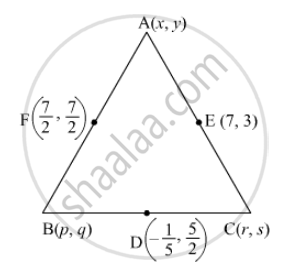
The midpoint of BC is \[D\left( - \frac{1}{5}, \frac{5}{2} \right)\],
The midpoint of AB is \[F\left( \frac{7}{2}, \frac{7}{2} \right)\] ,
The midpoint of AC is \[E\left( 7, 3 \right)\] Consider the line segment BC,
\[ \Rightarrow p + r = - 1 ; q + s = 5 . . . . . (i)\]
\[\text{ Consider the line segment AB, } \]
\[ \Rightarrow \frac{p + x}{2} = \frac{7}{2} ; \frac{q + y}{2} = \frac{7}{2}\]
\[ \Rightarrow p + x = 7 ; q + y = 7 . . . . . (ii)\]
\[\text{ Consider the line segment AC, } \]
\[ \Rightarrow \frac{r + x}{2} = 7 ; \frac{s + y}{2} = 3\]
\[ \Rightarrow r + x = 14 ; s + y = 6 . . . . . (iii)\]
Solve (i), (ii) and (iii) to get
\[BC = \sqrt{\left( - 4 - 3 \right)^2 + \left( 3 - 2 \right)^2} = \sqrt{50}\]
\[\text{ Equation of the line BC is } \]
\[\frac{x + 4}{- 4 - 3} = \frac{y - 3}{3 - 2}\]
\[ \Rightarrow x + 7y - 17 = 0\]
\[\text{ The perpendicular distance from a point } P\left( x_1 , y_1 \right)is\]
\[P = \left| \frac{1\left( 11 \right) + 7\left( 4 \right) - 17}{\sqrt{50}} \right| = \frac{22}{\sqrt{50}}\]
The area of the triangle is \[A = \frac{1}{2} \times \sqrt{50} \times \frac{22}{\sqrt{50}} = 11 \text{ sq . units } \]
APPEARS IN
RELATED QUESTIONS
Find a point on the x-axis which is equidistant from the points (7, 6) and (−3, 4).
If A and B are (1, 4) and (5, 2) respectively, find the coordinates of P when AP/BP = 3/4.
Determine the ratio in which the point P (m, 6) divides the join of A(−4, 3) and B(2, 8). Also, find the value of m.
Prove that the diagonals of a rectangle ABCD with vertices A(2,-1), B(5,-1) C(5,6) and D(2,6) are equal and bisect each other
Show that the points (−2, 3), (8, 3) and (6, 7) are the vertices of a right triangle ?
Find the coordinates of the circumcentre of a triangle whose vertices are (–3, 1), (0, –2) and (1, 3).
Find the possible pairs of coordinates of the fourth vertex D of the parallelogram, if three of its vertices are A(5, 6), B(1, –2) and C(3, –2).
Two points having same abscissae but different ordinate lie on
ABCD is a parallelogram with vertices \[A ( x_1 , y_1 ), B \left( x_2 , y_2 \right), C ( x_3 , y_3 )\] . Find the coordinates of the fourth vertex D in terms of \[x_1 , x_2 , x_3 , y_1 , y_2 \text{ and } y_3\]
If the vertices of a triangle are (1, −3), (4, p) and (−9, 7) and its area is 15 sq. units, find the value(s) of p.
Find the value of k, if the points A(7, −2), B (5, 1) and C (3, 2k) are collinear.
If the mid-point of the segment joining A (x, y + 1) and B (x + 1, y + 2) is C \[\left( \frac{3}{2}, \frac{5}{2} \right)\] , find x, y.
If the centroid of a triangle is (1, 4) and two of its vertices are (4, −3) and (−9, 7), then the area of the triangle is
The coordinates of the point P dividing the line segment joining the points A (1, 3) and B(4, 6) in the ratio 2 : 1 are
The point on the x-axis which is equidistant from points (−1, 0) and (5, 0) is
Students of a school are standing in rows and columns in their playground for a drill practice. A, B, C and D are the positions of four students as shown in figure. Is it possible to place Jaspal in the drill in such a way that he is equidistant from each of the four students A, B, C and D? If so, what should be his position?
Point (0, –7) lies ______.
The perpendicular distance of the point P(3, 4) from the y-axis is ______.
If the points P(1, 2), Q(0, 0) and R(x, y) are collinear, then find the relation between x and y.
Given points are P(1, 2), Q(0, 0) and R(x, y).
The given points are collinear, so the area of the triangle formed by them is `square`.
∴ `1/2 |x_1(y_2 - y_3) + x_2(y_3 - y_1) + x_3(y_1 - y_2)| = square`
`1/2 |1(square) + 0(square) + x(square)| = square`
`square + square + square` = 0
`square + square` = 0
`square = square`
Hence, the relation between x and y is `square`.
The distance of the point (–6, 8) from x-axis is ______.
