Advertisements
Advertisements
प्रश्न
\[A\left( 6, 1 \right) , B(8, 2) \text{ and } C(9, 4)\] are three vertices of a parallelogram ABCD . If E is the mid-point of DC , find the area of \[∆\] ADE.
Advertisements
उत्तर
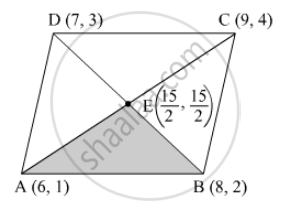
Three vertices are given, then D can be calulated and it comes out to be (7, 3).
Since, E is midpoint of BD.
Therefore, coordinates of E are \[\left( \frac{15}{2}, \frac{5}{2} \right)\] .
Now, vertices of triangle ABE rae (6, 1), (8, 2) and \[\left( \frac{15}{2}, \frac{5}{2} \right)\] .
\[\Rightarrow \text{ Area of the ∆ ABE } = \frac{1}{2}\begin{vmatrix}1 & 6 & 1 \\ 1 & 8 & 2 \\ 1 & \frac{15}{2} & \frac{5}{2}\end{vmatrix}\]
\[ = \frac{1}{2}\left[ 1\left( 20 - 15 \right) - 6\left( \frac{5}{2} - 2 \right) + 1\left( \frac{15}{2} - 8 \right) \right]\]
\[ = \frac{1}{2}\left[ 5 - \frac{6}{2} - \frac{1}{2} \right]\]
\[ = \frac{3}{4} \text{ aq . units } \]
APPEARS IN
संबंधित प्रश्न
Let ABCD be a square of side 2a. Find the coordinates of the vertices of this square when A coincides with the origin and AB and AD are along OX and OY respectively.
The points (3, -4) and (-6, 2) are the extremities of a diagonal of a parallelogram. If the third vertex is (-1, -3). Find the coordinates of the fourth vertex.
Find the ratio in which the line segment joining (-2, -3) and (5, 6) is divided by x-axis Also, find the coordinates of the point of division in each case.
The points A(2, 0), B(9, 1) C(11, 6) and D(4, 4) are the vertices of a quadrilateral ABCD. Determine whether ABCD is a rhombus or not.
Find the points on the x-axis, each of which is at a distance of 10 units from the point A(11, –8).
The line segment joining A( 2,9) and B(6,3) is a diameter of a circle with center C. Find the coordinates of C
Find the ratio in which the pint (-3, k) divide the join of A(-5, -4) and B(-2, 3),Also, find the value of k.
If `P(a/2,4)`is the mid-point of the line-segment joining the points A (−6, 5) and B(−2, 3), then the value of a is
Point P(x, 4) lies on the line segment joining the points A(−5, 8) and B(4, −10). Find the ratio in which point P divides the line segment AB. Also find the value of x.
Show that `square` ABCD formed by the vertices A(-4,-7), B(-1,2), C(8,5) and D(5,-4) is a rhombus.
ΔXYZ ∼ ΔPYR; In ΔXYZ, ∠Y = 60o, XY = 4.5 cm, YZ = 5.1 cm and XYPY =` 4/7` Construct ΔXYZ and ΔPYR.
Find the centroid of the triangle whose vertices is (−2, 3) (2, −1) (4, 0) .
Find the value of a so that the point (3, a) lies on the line represented by 2x − 3y + 5 = 0
What is the distance between the points \[A\left( \sin\theta - \cos\theta, 0 \right)\] and \[B\left( 0, \sin\theta + \cos\theta \right)\] ?
If the points A (1,2) , O (0,0) and C (a,b) are collinear , then find a : b.
If points (t, 2t), (−2, 6) and (3, 1) are collinear, then t =
If the area of the triangle formed by the points (x, 2x), (−2, 6) and (3, 1) is 5 square units , then x =
What is the nature of the line which includes the points (-5, 5), (6, 5), (-3, 5), (0, 5)?
In which quadrant, does the abscissa, and ordinate of a point have the same sign?
