मराठी

In Fig. 14.36, a Right Triangle Boa is Given C is the Mid-point of the Hypotenuse Ab. Show that It is Equidistant from the Vertices O, a and B.

Advertisements
Advertisements

प्रश्न

In Fig. 14.36, a right triangle BOA is given C is the mid-point of the hypotenuse AB. Show that it is equidistant from the vertices O, A  and B. 
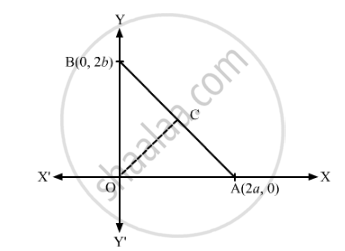
    

We have a right angled triangle,`triangle BOA`  right angled at O. Co-ordinates are B (0,2b); A (2a0) and C (0, 0).


Advertisements

उत्तर

We have to prove that mid-point C of hypotenuse AB is equidistant from the vertices.

In general to find the mid-pointP(x,y)  of two points`A(x_1,y_1)`and `B (x_2,y_2)` we use section formula as, 

`p(x,y)=((x_1+x_2)/2,(y_1+y_2)/2)` 

So co-rdinates of C is , 

C (a,b) 

In general, the distance between` A(x_1,y_2)` and `B(x_2,y_2)`is given by, 

`AB=sqrt((x_2-x_1)^2+(y_2-y_1)^2)` 

So, 

`CO=sqrt((a-0)^2+(b0o)^2)` 

`=sqrt(a^2+b^2)`

`CB =sqrt((a-0)^2+(b-2b)^2)` 

`sqrt(a^2+b^2)` 

`CA=sqrt((a-2a)^2+(b-0)^2)

`sqrt(a^2+b^2` 

Hence, mid-point  C of hypotenuse AB is equidistant from the vertices.

shaalaa.com
  या प्रश्नात किंवा उत्तरात काही त्रुटी आहे का?
पाठ 6: Co-ordinate Geometry - Exercise 6.4 [पृष्ठ ३७]

APPEARS IN

आर.डी. शर्मा Mathematics [English] Class 10
पाठ 6 Co-ordinate Geometry
Exercise 6.4 | Q 10 | पृष्ठ ३७

व्हिडिओ ट्यूटोरियलVIEW ALL [2]

संबंधित प्रश्‍न

(Street Plan): A city has two main roads which cross each other at the centre of the city. These two roads are along the North-South direction and East-West direction.

All the other streets of the city run parallel to these roads and are 200 m apart. There are 5 streets in each direction. Using 1cm = 200 m, draw a model of the city on your notebook. Represent the roads/streets by single lines.

There are many cross- streets in your model. A particular cross-street is made by two streets, one running in the North - South direction and another in the East - West direction. Each cross street is referred to in the following manner : If the 2nd street running in the North - South direction and 5th in the East - West direction meet at some crossing, then we will call this cross-street (2, 5). Using this convention, find:

  1. how many cross - streets can be referred to as (4, 3).
  2. how many cross - streets can be referred to as (3, 4).

Find the value of x such that PQ = QR where the coordinates of P, Q and R are (6, -1), (1, 3) and (x, 8) respectively.


The points A(2, 0), B(9, 1) C(11, 6) and D(4, 4) are the vertices of a quadrilateral ABCD. Determine whether ABCD is a rhombus or not.


Find the points on the y-axis which is equidistant form the points A(6,5)  and B(- 4,3) 


In what ratio does the line x - y - 2 = 0 divide the line segment joining the points A (3, 1) and B (8, 9)? 


The base BC of an equilateral triangle ABC lies on y-axis. The coordinates of point C are (0, −3). The origin is the midpoint of the base. Find the coordinates of the points A and B. Also, find the coordinates of another point D such that ABCD is a rhombus.


ΔXYZ ∼ ΔPYR; In ΔXYZ, ∠Y = 60o, XY = 4.5 cm, YZ = 5.1 cm and XYPY =` 4/7` Construct ΔXYZ and ΔPYR.


If the point  \[C \left( - 1, 2 \right)\] divides internally the line segment joining the points  A (2, 5)  and Bx) in the ratio 3 : 4 , find the value of x2 + y2 .


If three points (x1, y1) (x2, y2), (x3, y3) lie on the same line, prove that  \[\frac{y_2 - y_3}{x_2 x_3} + \frac{y_3 - y_1}{x_3 x_1} + \frac{y_1 - y_2}{x_1 x_2} = 0\]


Write the coordinates the reflections of points (3, 5) in X and Y -axes.


Write the ratio in which the line segment doining the points A (3, −6), and B (5, 3) is divided by X-axis.


Find the value of a so that the point (3, a) lies on the line represented by 2x − 3y + 5 = 0


Find the coordinates of the point which is equidistant from the three vertices A (\[2x, 0) O (0, 0) \text{ and }  B(0, 2y) of ∆\]  AOB .


The distance between the points (a cos θ + b sin θ, 0) and (0, a sin θ − b cos θ) is


If A (5, 3), B (11, −5) and P (12, y) are the vertices of a right triangle right angled at P, then y=


The length of a line segment joining A (2, −3) and B is 10 units. If the abscissa of B is 10 units, then its ordinates can be


In the above figure, seg PA, seg QB and RC are perpendicular to seg AC. From the information given in the figure, prove that: `1/x + 1/y = 1/z`


Point (–10, 0) lies ______.


If the coordinate of point A on the number line is –1 and that of point B is 6, then find d(A, B).


Share
Notifications

Englishहिंदीमराठी


      Forgot password?
Use app×