Advertisements
Advertisements
Question
Point A lies on the line segment PQ joining P(6, -6) and Q(-4, -1) in such a way that `(PA)/( PQ)=2/5` . If that point A also lies on the line 3x + k( y + 1 ) = 0, find the value of k.
Advertisements
Solution
Let the coordinates of A be`(x,y) Here (PA)/(PQ) = 2/5 . so ,`
PA + AQ= PQ
`⇒PA +AQ =(5PA)/2 [∵ PA = 2/5 PQ]`
` ⇒AQ = (5PA)/2 - PA`
`⇒ (AQ)/(PA) = 3/2 `
`⇒ (PA)/(AQ) = 2/3 `
Let (x, y) be the coordinates of A, which dives PQ in the ratio 2 : 3 internally Then using section formula, we get
` X = (2 xx (-4) +3 xx (6))/(2+3) = (-8+18)/5= 10/5 = 2`
`y = (2 xx (-1) + 3 xx(-6))/(2+3) = (-2-18)/5 = (-20)/5 = -4`
Now, the point ( 2, -4 ) lies on the line 3x +k(y+1) = 0 ,therefore
3 × 2 +k(-4+1)=0
⇒ 3k = 6
`⇒ k =6/3 =2`
Hence, k=2.
RELATED QUESTIONS
Two vertices of an isosceles triangle are (2, 0) and (2, 5). Find the third vertex if the length of the equal sides is 3.
Which point on the y-axis is equidistant from (2, 3) and (−4, 1)?
Find the centre of the circle passing through (5, -8), (2, -9) and (2, 1).
Show that the points (−3, 2), (−5,−5), (2, −3) and (4, 4) are the vertices of a rhombus. Find the area of this rhombus.
In Fig. 14.36, a right triangle BOA is given C is the mid-point of the hypotenuse AB. Show that it is equidistant from the vertices O, A and B.
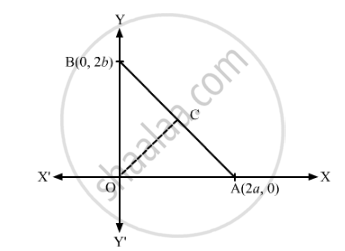
We have a right angled triangle,`triangle BOA` right angled at O. Co-ordinates are B (0,2b); A (2a, 0) and C (0, 0).
Show that the points A (1, 0), B (5, 3), C (2, 7) and D (−2, 4) are the vertices of a parallelogram.
Show that the following points are the vertices of a square:
A (0,-2), B(3,1), C(0,4) and D(-3,1)
The abscissa of any point on y-axis is
The perpendicular distance of the P (4,3) from y-axis is
ABCD is a parallelogram with vertices \[A ( x_1 , y_1 ), B \left( x_2 , y_2 \right), C ( x_3 , y_3 )\] . Find the coordinates of the fourth vertex D in terms of \[x_1 , x_2 , x_3 , y_1 , y_2 \text{ and } y_3\]
If points Q and reflections of point P (−3, 4) in X and Y axes respectively, what is QR?
Find the area of triangle with vertices ( a, b+c) , (b, c+a) and (c, a+b).
The distance between the points (a cos θ + b sin θ, 0) and (0, a sin θ − b cos θ) is
If A (5, 3), B (11, −5) and P (12, y) are the vertices of a right triangle right angled at P, then y=
If the sum of X-coordinates of the vertices of a triangle is 12 and the sum of Y-coordinates is 9, then the coordinates of centroid are ______.
The distance of the point P(2, 3) from the x-axis is ______.
If y-coordinate of a point is zero, then this point always lies ______.
The coordinates of a point whose ordinate is `-1/2` and abscissa is 1 are `-1/2, 1`.
The coordinates of two points are P(4, 5) and Q(–1, 6). Find the difference between their abscissas.
Assertion (A): The ratio in which the line segment joining (2, -3) and (5, 6) internally divided by x-axis is 1:2.
Reason (R): as formula for the internal division is `((mx_2 + nx_1)/(m + n) , (my_2 + ny_1)/(m + n))`
