Advertisements
Advertisements
प्रश्न
The base QR of a n equilateral triangle PQR lies on x-axis. The coordinates of the point Q are (-4, 0) and origin is the midpoint of the base. Find the coordinates of the points P and R.
Advertisements
उत्तर
Let(x ,0) be the coordinates of R. Then
`0= (-4+x)/2 ⇒ x =4`
Thus, the coordinates of R are (4,0) . Here, PQ = QR = PR and the coordinates of P lies on . y - axis Let the coordinates of P be
(0,y) . Then ,
`PQ = QR ⇒ PQ^2 = QR^2`
`⇒ (0+4)^2 +(y-0)^2 = 8^2`
`⇒ y^2 = 64-16=48`
`⇒ y = +- 4 sqrt(3)`
`"Hence, the required coordinates are " R (4,0) and P (0,4 sqrt(3) ) or P (0, -4 sqrt(3) ).`
APPEARS IN
संबंधित प्रश्न
On which axis do the following points lie?
R(−4,0)
Name the quadrilateral formed, if any, by the following points, and given reasons for your answers:
A(-3, 5) B(3, 1), C (0, 3), D(-1, -4)
If three consecutive vertices of a parallelogram are (1, -2), (3, 6) and (5, 10), find its fourth vertex.
Find the coordinates of the midpoints of the line segment joining
P(-11,-8) and Q(8,-2)
Points A(-1, y) and B(5,7) lie on the circle with centre O(2, -3y).Find the value of y.
Find the ratio in which the line segment joining the points A (3, 8) and B (–9, 3) is divided by the Y– axis.
Prove hat the points A (2, 3) B(−2,2) C(−1,−2), and D(3, −1) are the vertices of a square ABCD.
If A(−3, 5), B(−2, −7), C(1, −8) and D(6, 3) are the vertices of a quadrilateral ABCD, find its area.
Find the value of k, if the points A (8, 1) B(3, −4) and C(2, k) are collinear.
If (−1, 2), (2, −1) and (3, 1) are any three vertices of a parallelogram, then
The line segment joining points (−3, −4), and (1, −2) is divided by y-axis in the ratio.
The ratio in which the x-axis divides the segment joining (3, 6) and (12, −3) is
If the centroid of the triangle formed by the points (a, b), (b, c) and (c, a) is at the origin, then a3 + b3 + c3 =
The coordinates of the fourth vertex of the rectangle formed by the points (0, 0), (2, 0), (0, 3) are
The ratio in which the line segment joining P (x1, y1) and Q (x2, y2) is divided by x-axis is
f the coordinates of one end of a diameter of a circle are (2, 3) and the coordinates of its centre are (−2, 5), then the coordinates of the other end of the diameter are
In Fig. 14.46, the area of ΔABC (in square units) is
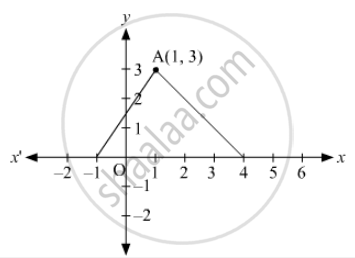
If A(x, 2), B(−3, −4) and C(7, −5) are collinear, then the value of x is
Point (0, –7) lies ______.
The perpendicular distance of the point P(3, 4) from the y-axis is ______.
