English

In Fig. 14.46, the Area of δAbc (In Square Units) is - Mathematics

Advertisements
Advertisements

Question

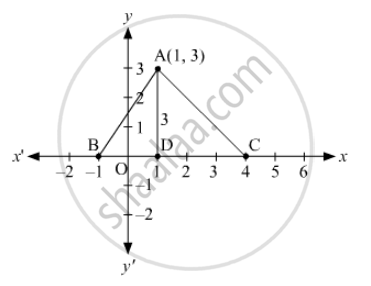
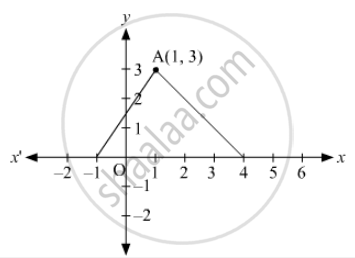
 In Fig. 14.46, the area of ΔABC (in square units) is
Options

  • 15

  • 10

  • 7.5

  • 2.5

MCQ
Advertisements

Solution


The coordinates of A are (1, 3).
∴ Distance of A from the x-axis, AD = y-coordinate of A = 3 units
The number of units between B and C on the x-axis are 5.
∴ BC = 5 units
Now,
Area of ∆ABC = \[\frac{1}{2} \times BC \times AD = \frac{1}{2} \times 5 \times 3 = \frac{15}{2} = 7 . 5\]  square units

Thus, the area of ∆ABC is 7.5 square units.


shaalaa.com
  Is there an error in this question or solution?
Chapter 6: Co-Ordinate Geometry - Exercise 6.7 [Page 66]

APPEARS IN

RD Sharma Mathematics [English] Class 10
Chapter 6 Co-Ordinate Geometry
Exercise 6.7 | Q 43 | Page 66

Video TutorialsVIEW ALL [2]

RELATED QUESTIONS

The base PQ of two equilateral triangles PQR and PQR' with side 2a lies along y-axis such that the mid-point of PQ is at the origin. Find the coordinates of the vertices R and R' of the triangles.


In the seating arrangement of desks in a classroom three students Rohini, Sandhya and Bina are seated at A(3, 1), B(6, 4), and C(8, 6). Do you think they are seated in a line?


If the coordinates of the mid-points of the sides of a triangle be (3, -2), (-3, 1) and (4, -3), then find the coordinates of its vertices.


The line joining the points (2, 1) and (5, −8) is trisected at the points P and Q. If point P lies on the line 2x − y + k = 0. Find the value of k.


If the poin A(0,2)  is equidistant form the points B (3, p) and  C (p ,5) find the value of p. Also, find the length of AB.


Find the points on the y-axis which is equidistant form the points A(6,5)  and B(- 4,3) 


Find the ratio in which the point P(m, 6) divides the join of A(-4, 3) and B(2, 8) Also, find the value of m. 


The base QR of a n equilateral triangle PQR lies on x-axis. The coordinates of the point Q are (-4, 0) and origin is the midpoint of the base. Find the coordinates of the points P and R.


Point P(x, 4) lies on the line segment joining the points A(−5, 8) and B(4, −10). Find the ratio in which point P divides the line segment AB. Also find the value of x.


Show that A(-4, -7), B(-1, 2), C(8, 5) and D(5, -4) are the vertices of a
rhombus ABCD.


ΔXYZ ∼ ΔPYR; In ΔXYZ, ∠Y = 60o, XY = 4.5 cm, YZ = 5.1 cm and XYPY =` 4/7` Construct ΔXYZ and ΔPYR.


Write the perimeter of the triangle formed  by the points O (0, 0), A (a, 0) and B (0, b).


What is the distance between the points  \[A\left( \sin\theta - \cos\theta, 0 \right)\] and \[B\left( 0, \sin\theta + \cos\theta \right)\] ?


If the area of the triangle formed by the points (x, 2x), (−2, 6)  and (3, 1) is 5 square units , then x =


The length of a line segment joining A (2, −3) and B is 10 units. If the abscissa of B is 10 units, then its ordinates can be


The coordinates of the point P dividing the line segment joining the points A (1, 3) and B(4, 6) in the ratio 2 : 1 are


The point on the x-axis which is equidistant from points (−1, 0) and (5, 0) is


Write the equations of the x-axis and y-axis. 


In the above figure, seg PA, seg QB and RC are perpendicular to seg AC. From the information given in the figure, prove that: `1/x + 1/y = 1/z`


Share
Notifications

Englishहिंदीमराठी


      Forgot password?
Use app×