Advertisements
Advertisements
Question
∆ABC with vertices A(–2, 0), B(2, 0) and C(0, 2) is similar to ∆DEF with vertices D(–4, 0), E(4, 0) and F(0, 4).
Options
True
False
Advertisements
Solution
This statement is True.
Explanation:
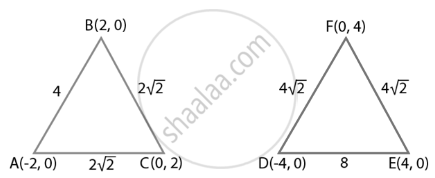
Using distance formula,
d = `sqrt((x_2 - x_1)^2 + (y_2 - y_1)^2`
We can find,
AB = `sqrt((2 + 2)^2 + 0) = sqrt(16)` = 4
BC = `sqrt((0 - 2)^2 + (2 - 0)^2) = sqrt(8) = 2sqrt(2)`
CA = `sqrt((-2 - 0)^2 + (0 - 2)^2) = sqrt(8) = 2sqrt(2)`
DE = `sqrt((4 + 4)^2 + 0) = sqrt(64)` = 8
EF = `sqrt((0 - 4)^2 + (4 - 0)^2) = sqrt(32) = 4sqrt(2)`
FD = `sqrt((-4 - 0)^2 + (0 - 4)^2) = sqrt(32) = 4sqrt(2)`
∴ `("AB")/("DE") = ("BC")/("EF") = ("CA")/("FD") = 1/2`
⇒ ΔABC ∼ ΔDEF
Hence, triangle ABC and DEF are similar.
APPEARS IN
RELATED QUESTIONS
If two vertices of an equilateral triangle be (0, 0), (3, √3 ), find the third vertex
Find the distance between the points (0, 0) and (36, 15). Can you now find the distance between the two towns A and B discussed in Section 7.2.
Check whether (5, -2), (6, 4) and (7, -2) are the vertices of an isosceles triangle.
Find the value of a when the distance between the points (3, a) and (4, 1) is `sqrt10`
Find the circumcenter of the triangle whose vertices are (-2, -3), (-1, 0), (7, -6).
Show that the points A(1, 2), B(1, 6), C(1 + 2`sqrt3`, 4) are vertices of an equilateral triangle.
Find the distance between the following point :
(p+q,p-q) and (p-q, p-q)
Prove that the following set of point is collinear :
(5 , 5),(3 , 4),(-7 , -1)
x (1,2),Y (3, -4) and z (5,-6) are the vertices of a triangle . Find the circumcentre and the circumradius of the triangle.
Prove that the points (6 , -1) , (5 , 8) and (1 , 3) are the vertices of an isosceles triangle.
Prove that the points (0 , 0) , (3 , 2) , (7 , 7) and (4 , 5) are the vertices of a parallelogram.
Find the distance between the origin and the point:
(-5, -12)
Given A = (x + 2, -2) and B (11, 6). Find x if AB = 17.
By using the distance formula prove that each of the following sets of points are the vertices of a right angled triangle.
(i) (6, 2), (3, -1) and (- 2, 4)
(ii) (-2, 2), (8, -2) and (-4, -3).
Show that the quadrilateral with vertices (3, 2), (0, 5), (- 3, 2) and (0, -1) is a square.
The distance between point P(2, 2) and Q(5, x) is 5 cm, then the value of x ______
Find distance between point A(– 3, 4) and origin O
Find distance between point A(7, 5) and B(2, 5)
Show that the point (11, – 2) is equidistant from (4, – 3) and (6, 3)
The coordinates of the point which is equidistant from the three vertices of the ΔAOB as shown in the figure is ______.

