Advertisements
Advertisements
Question
Plot the following points and write the name of the figure obtained by joining them in order:
P(– 3, 2), Q(– 7, – 3), R(6, – 3), S(2, 2)
Advertisements
Solution
Let X’ OX and Y’ OY be the coordinate axes and mark point on it. Here, point P(– 3, 2) lies in II quadrant, Q(– 7, – 3) lies in III quadrant, R(6, – 3) lies in IV quadrant and S(2, 2) lies in I quadrant. Plotting the points on the graph paper, the figure obtained is trapezium PQRS.

APPEARS IN
RELATED QUESTIONS
Plot the following point on the graph paper:
(4, −3)
Plot the following point on the graph paper:
(−3, 2)
On a graph paper plot the points A (3, 0), B(3, 3), C(0, 3). Join A, B and B, C. What is the figure formed?
Find the quadrants without plotting the point on a graph sheet
(3, −4)
Plot the following point in a graph sheet.
A(5, 2)
Find the quadrants without plotting the point on a graph sheet.
(−9, 50)
Plot the following point in a graph sheet.
I(2, 3)
If P(–1, 1), Q(3, –4), R(1, –1), S(–2, –3) and T(–4, 4) are plotted on the graph paper, then the point(s) in the fourth quadrant are ______.
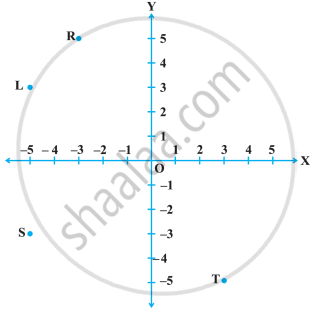
In the following figure, the point identified by the coordinates (–5, 3) is ______.
Plot the points (x, y) given by the following table. Use scale 1 cm = 0.25 units
| x | 1.25 | 0.25 | 1.5 | – 1.75 |
| y | – 0.5 | 1 | 1.5 | – 0.25 |
