Advertisements
Advertisements
Question
Name two compounds that are covalent when taken pure but produce ions when dissolved in water.
Advertisements
Solution
HCl and NH3
APPEARS IN
RELATED QUESTIONS
Elements forming ionic compounds attain noble gas configuration by either gaining or losing electrons from their outermost shells. Give reason to explain why carbon cannot attain noble gas configuration in this manner to form its compounds.
Explain the nature of the covalent bond using the bond formation in CH3Cl.
Give appropriate scientific reasons for Carbon tetrachloride does not conduct electricity.
What type of chemical bond is formed between:
Carbon and bromine
The electronic configurations of three elements X, Y and Z are as follows:
| X | 2, 4 |
| Y | 2, 7 |
| Z | 2, 1 |
- Which two elements will combine to form an ionic compound?
- Which two elements will react to form a covalent compound?
Give reasons for your choice.
What happens when methane (natural gas) burns in air? Write the chemical equation of the reaction involved.
Explain the following term with example.
Covalent bond
Complete the following activity.
Write the names of the hydrocarbons for the following structural formula.
(isobutylene, cyclohexane, propene, cyclohexene, cyclopentane, benzene, propyne, isobutane, propane)
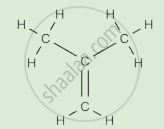 |
Complete the following activity.
Write the names of the hydrocarbons for the following structural formula.
(isobutylene, cyclohexane, propene, cyclohexene, cyclopentane, benzene, propyne, isobutane, propane)
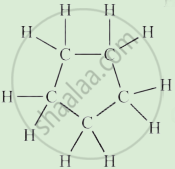 |
Cation is formed when ______.
