Advertisements
Advertisements
Question
Match the items of column I with items of column II.
| Column I | Column II | |
| (i) | Antifreeze used in car engine | (a) Neutral ferric chloride |
| (ii) | Solvent used in perfumes | (b) Glycerol |
| (iii) | Starting material for picric acid | (c) Methanol |
| (iv) | Wood spirit | (d) Phenol |
| (v) | Reagent used for detection of phenolic group | (e) Ethleneglycol |
| (vi) | By product of soap industry used in cosmetics | (f) Ethanol |
Advertisements
Solution
| Column I | Column II | |
| (i) | Antifreeze used in car engine | (e) Ethleneglycol |
| (ii) | Solvent used in perfumes | (f) Ethanol |
| (iii) | Starting material for picric acid | (d) Phenol |
| (iv) | Wood spirit | (c) Methanol |
| (v) | Reagent used for detection of phenolic group | (a) Neutral ferric chloride |
| (vi) | By product of soap industry used in cosmetics | (b) Glycerol |
Explanation:
(i) IUPAC name of ethylene glycol is ethane-1, 2-diol. It is primarily used as raw material in the manufacturing of polyester fibers and fabric industry. A small percentage of it is used in antifreeze formulations.
(ii) Ethanol is a good solvent for fatty and waxy substances. Fats and waxes provide odour to the perfumes. Apart from being a good solvent, it is less irritating to the skin. So, it is used in perfumes.
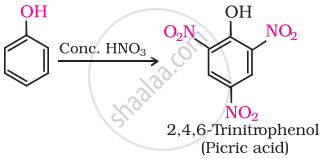
(iii) Phenol is converted into picric acid (2, 4, 6-trinitro-phenol) by the reaction of phenol with cone. \[\ce{HNO3}\].
(iv) Methanol, \[\ce{CH3OH}\] is also known as ‘wood spirit’ as it was produced by the destructive distillation of wood.
(v) Neutral ferric chloride give purple/red colour when treated with phenols. It is the reagent used for detection of phenolic group.
(vi) Soaps are prepared by the reactions of fatty acid with \[\ce{NaOH}\].
\[\begin{array}{cc}
\ce{O}\phantom{..........................................}\\
||\phantom{..........................................}\\
\ce{CH2 - O - C - OC17H35}\phantom{...........................}\phantom{.......}\ce{CH2OH}\phantom{.}\\
\phantom{.}
\phantom{.........}|\phantom{..........}\ce{O}\phantom{.............................................}|\phantom{.................}\\
||\phantom{...........................................}\\
\ce{CH - O - C - OC17H35 + 3NaOH -> \underset{(soap)}{\underset{Sodium stearate}{3C17H35COONa}} + CHOH}\phantom{..}\\
\phantom{..}|\phantom{.........................................................}|\phantom{.........}\\
\phantom{}\ce{CH2 - O - C -OC17H35}\phantom{..................................}\ce{\underset{Glycerol}{CH2OH}}\phantom{}\\
||\phantom{........................................}\\
\ce{O}\phantom{........................................}\\
\end{array}\]
The glycerol (propan-1, 2, 3-triol) is the by product of saop industry and used in cosmetics.
APPEARS IN
RELATED QUESTIONS
How do you convert the following:
Ethanol to Propan-2-ol
If ethanol dissolves in water, then which of the following would be observed:
Wood spirit is known as acetone:
Phenol can be distinguished from ethanol by the reactions with:
(i) \[\ce{Br2/water}\]
(ii) \[\ce{Na}\]
(iii) Neutral \[\ce{FeCl3}\]
(iv) All the above
Write the IUPAC name of the following compound.
\[\begin{array}{cc}
\phantom{.}\ce{CH3 - CH - CH - CH - CH - CH3}\phantom{}\\
\phantom{......}|\phantom{......}|\phantom{......}|\phantom{.....}|\phantom{........}\\
\phantom{...}\ce{CH3}\phantom{...}\ce{OH}\phantom{...}\ce{C2H5}\phantom{.}\ce{OH}\phantom{...}\end{array}\]
What is denatured alcohol?
Out of 2-chloroethanol and ethanol which is more acidic and why?
Suggest a reagent for conversion of ethanol to ethanoic acid.
Arrange the following compounds in increasing order of acidity and give a suitable explanation.
Phenol, o-nitrophenol, o-cresol
Match the items of column I with items of column II.
| Column I | Column II | |
| (i) | Methanol | (a) Conversion of phenol to o-hydroxysalicylic acid |
| (ii) | Kolbe’s reaction | (b) Ethyl alcohol |
| (iii) | Williamson’s synthesis | (c) Conversion of phenol to salicylaldehyde |
| (iv) | Conversion of 2° alcohol to ketone | (d) Wood spirit |
| (v) | Reimer-Tiemann reaction | (e) Heated copper at 573 K |
| (vi) | Fermentation | (f) Reaction of alkyl halide with sodium alkoxide |
Assertion: Ethanol is a weaker acid than phenol.
Reason: Sodium ethoxide may be prepared by the reaction of ethanol with aqueous \[\ce{NaOH}\].
Which reagent can convert acetic acid into ethanol?
Tonics in general contain
If the starting material is 1-methyl-1,2-epoxy cyclopentane, of absolute configuration, decide which one compound correctly represents the product of its reaction with sodium methoxide in methanol.
How methanol is obtained from methanal.
3, 3-dimethyl-1-butene was subject to following reactions: