Advertisements
Advertisements
Question
Match the columns :
| A | B |
| (1) Theseus | (1) Robin Goodfellow |
| (2) Titania | (2) Queen of the Amazons |
| (3) Puck | (3) Duke of Athens |
| (4) Hippolyta | (4) Faeries |
| (5) Cobweb, Moth | (5) Queen of the Faeries |
Advertisements
Solution
| A | B |
| (1) Theseus | (3) Duke of Athens |
| (2) Titania | (5) Queen of the Faeries |
| (3) Puck | (1) Robin Goodfellow |
| (4) Hippolyta | (2) Queen of the Amazons |
| (5) Cobweb, Moth | (4) Faeries |
APPEARS IN
RELATED QUESTIONS
Answer any six of the following questions in 30‒40 words:
(a) Why did Gandhiji feel that taking the Champaran case to the court was useless?
(b) Why did the peddler derive pleasure from his idea of the world as a rattrap?
(c) How is Mukesh different from the other bangle makers of Firozabad?
(d) What tempted Franz to stay away from school?
(e) Why did the maharaja ban tiger hunting in the state?
(f) How was the skunk's story different from the other stories narrated by Jack?
(g) Which words of her brother made a deep impression on Bama?
What role did Mr. Gilman play in Helen Keller's life? (120‒150 words)
Answer any four of the following in 30–40 words each :
(a) Describe the irony in Saheb's name.
(b) Why was Gandhiji opposed to C.F. Andrews helping him in Champaran?
(c) Aunt Jennifer's efforts to get rid of her fear proved to be futile. Comment.
(d) What does Stephen Spender want to be done for the children of the school in a slum?
(e) When he was only ten days old, a prediction was made about the future of the Tiger King. What was ironic about it?
(f) What was his father's chief concern about Dr. Sadao?
Answer any four of the following in 30 − 40 words each :
(a) What does Saheb look for in the garbage dumps?
(b) How was Gandhi treated at Rajendra Prasad's house?
(c) Why does one feel 'a sudden strangeness' on counting to twelve and keeping quiet?
(d) Mention any two things which cause pain and suffering. (A Thing of Beauty)
(e) When was the Tiger King in danger of losing his throne?
(f) What role did the American professor play in bringing Hana and Sadao together?
When and how did the people of Iping grow suspicious of the invisible man ?
Give reasons for the following statement.
The article has been titled ‘Silk Road.’
Is drama a good medium for conveying a social message? Discuss.
Look at the words given in the box below
|
snigger |
wriggle |
sneak |
squeak |
|
squawk |
titter |
pant |
chuckle |
|
giggle |
jeer |
chortle |
guffaw |
|
sigh |
sidle |
boo |
shriek |
|
scramble |
croak |
straggle |
plod |
|
gasp |
|
|
|
Now classify them according to their closeness in meaning to the words given below
|
A |
B |
C |
D |
E |
|
snigger |
wriggle |
squeak |
jeer |
sigh |
'New Literature' is a misnomer for the wealth of the Indian Literary tradition. How does G. N. Devy explain this?
Notice these expressions in the poem and guess their meaning from the context:
| rancid breath | squelching tar |
| spectroscopic flight of fancy | |
| rearing on the thunderclap | brunette |
| peroxide blonde | clinical assent |
| raven black |
Discuss in pairs or in small groups
What does a novel do?
Interpret these phrases in the context of the essay
- Mist of protection
- At a crossroads
- It came with strings attached
Using a dictionary/internet note down the main difference between a developing nation and a developed nation.
Discuss in groups, reasons/ consequences/ effects:
The cherry blossomed.
Kite - flying in Gujarat, is a competitive sport - cum - festival.
Discuss in groups and share with one another.
Do you spend time admiring and thinking over the beauties of nature? Elaborate on your response.
Form suitable groups and discuss the following.
You have heard/read stories of Akbar and Birbal, Tenali Raman, Mulla Nasruddin. Recollect and write down the names of those stories.
Pick out those aspects of a story that you find a common in all their stories.
- Humour
- Supernatural event
- Wisdom
- Suspense
- Magic
- Beauty of Nature
- Wit
- Play upon words
- Sadend
- Violence
What would happen if children didn’t go to school? Discuss the question in groups of 5-8 and prepare a short composition on it.
Draw a diagram to show a volcanic eruption from its description given in this passage. Label the diagram. Show the following in it :
Volcano; earth’s crust; crack in the earth’s crust; hot molten rock; red, hot lava; smoke; ash; burning chunks of rock.
Form groups and hold debates on the following topics. Make bulleted lists of points in favour of the topic (pros) and those against it (cons). (3-6 points each)
You should never lose a match.
Write a short note on the following:
Sujata’s offering
Read the following sentence aloud. Write who said it and to whom.
“Look, here’s something for you.”
What do the following event/action tell us about the characters? Discuss.
The Archbishop announced that everyone was free to try his hand at the sword and called all the Lords to a Tournament.
How long does the whole event described in this passage take? Work it out by reading the passage.
Write the symbol that is used in the poem to represent the following idea.
I made a rare choice.
Pick out the line that means:
Sing in such a manner:
The poet uses a free, conversational style in his poem. It is also called Colloquial style.
Pick out and write down such lines or expressions that support the above statement.
- ______ you have not done what I asked.
- _______________________.
- _______________________.
- _______________________.
- _______________________.
- _______________________.
Find out how the following game is played.
Lawn Tennis
Find out how the following game is played.
Kabaddi
List the characters in the play.
Human characters
When do the parents feel sorry and become unhappy?
Discuss the following in group.
Do’s and Don’ts for young children.
Find a picture of a computer with the help of your teacher and label the different parts you see.
For example, monitor, screen, speakers, processor, mouse, mousepad, keyboard, etc.
What is meant by 'Honour the white cane'?
What does 'Rangaawali' mean?
Describe the struggles underwent by the young seagull to overcome its fear of flying.
Share a memorable trip from your life
What made the reporter gaze at the author?
Is the bird a crow?
How did Hamid’s friends show that they enjoyed eating the sweets?
Pick out the words which rhyme with the given words and write similar rhyming words on your own.
| 1. | far | ||
| 2. | fear | ||
| 3. | low | ||
| 4. | kind | ||
| 5. | remain | ||
| 6. | they |
Identify the character/speaker.
You may stay if you answer my riddle.
Fill in the table
| Problems Faced By Mr. Fogg And His Team | Solution |
| The train stopped in the middle of the forest. | |
| They couldn’t hire the elephant. | |
| They were in need of an elephant driver. |
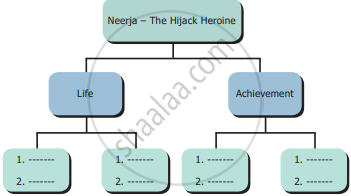
Write a summary based on the flow chart.
Amma bought the vegetables from the______.
Mother did not ask for______.
The little bird found a shallow hollow in the ground.
Read the lines and answer the questions given below.
Autumn is English
in red, yellow and brown
Autumn is Indian
Whenever leaves fell down
- How is autumn in India?
- Compare the English autumn with the Indian autumn.
What is the setting of the story?
The man didn’t want to get up because he was tired as he wcoas thrown into the ditch.
What would we do when we are happy or sad?
When do we land on Mars?
The hen-pigeon returned home when it started to _______.
Leaf cutter ants drink ______.
Write the word with same meaning.

pants- ______
The fir tree was sad ______.
Replace the bold word/words with a word from the quiver and re-write the sentence –
The teacher said something about his good handwriting. He felt very happy.
Who fell down and down and down?
On the basis of your understanding of the given passage, make notes in any appropriate format.
The Sherpas were nomadic people who first migrated from Tibet approximately 600 years ago, through the Nangpa La pass and settled in the Solukhumbu District, Nepal. These nomadic people then gradually moved westward along salt trade routes. During 14th century, Sherpa ancestors migrated from Kham. The group of people from the Kham region, east of Tibet, was called “Shyar Khamba”. The inhabitants of Shyar Khamba, were called Sherpa. Sherpa migrants travelled through Ü and Tsang, before crossing the Himalayas. According to Sherpa oral history, four groups migrated out of Solukhumbu at different times, giving rise to the four fundamental Sherpa clans: Minyagpa, Thimmi, Sertawa and Chawa. These four groups have since split into the more than 20 different clans that exist today
Sherpas had little contact with the world beyond the mountains and they spoke their own language. AngDawa, a 76-year-old former mountaineer recalled “My first expedition was to Makalu [the world’s fifth highest mountain] with Sir Edmund Hillary’’. We were not allowed to go to the top. We wore leather boots that got really heavy when wet, and we only got a little salary, but we danced the Sherpa dance, and we were able to buy firewood and make campfires, and we spent a lot of the time dancing and singing and drinking. Today Sherpas get good pay and good equipment, but they don’t have good entertainment. My one regret is that I never got to the top of Everest. I got to the South Summit, but I never got a chance to go for the top.
The transformation began when the Sherpa Tenzing Norgay and the New Zealander Edmund Hillary scaled Everest in 1953. Edmund Hillary took efforts to build schools and health clinics to raise the living standards of the Sherpas. Thus life in Khumbu improved due to the efforts taken by Edmund Hillary and hence he was known as ‘Sherpa King’.
Sherpas working on the Everest generally tend to perish one by one, casualties of crevasse falls, avalanches, and altitude sickness. Some have simply disappeared on the mountain, never to be seen again. Apart from the bad seasons in 1922, 1970 and 2014 they do not die en masse. Sherpas carry the heaviest loads and pay the highest prices on the world’s tallest mountain. In some ways, Sherpas have benefited from the commercialization of the Everest more than any group, earning income from thousands of climbers and trekkers drawn to the mountain. While interest in climbing Everest grew gradually over the decades after the first ascent, it wasn’t until the 1990s that the economic motives of commercial guiding on Everest began. This leads to eclipse the amateur impetus of traditional mountaineering. Climbers looked after each other for the love of adventure and “the brotherhood of the rope” now are tending to mountain businesses. Sherpas have taken up jobs as guides to look after clients for a salary. Commercial guiding agencies promised any reasonably fit person a shot at Everest.
What should we do to ensure Safe Surfing?
