Advertisements
Advertisements
Question
Match the phrases in Column A with their meanings in Column B.
| A | B | ||
| (i) | broke out | (a) | an attitude of kindness, a readiness to give freely |
| (ii) |
in accordance with |
(b) | was not able to tolerate |
| (iii) | a helping hand | (c) | began suddenly in a violent way |
| (iv) | could not stomach | (d) | assistance |
| (v) | generosity of spirit | (e) | persons with power to make decisions |
| (vi) | figures of authority | (f) | according to a particular rule, principle, or system |
Advertisements
Solution
| A | B | ||
| (i) | broke out | (c) |
began suddenly in a violent way |
| (ii) |
in accordance with |
(f) |
according to a particular rule, principle or system |
| (iii) | a helping hand | (d) | assistance |
| (iv) | could not stomach | (b) |
was unable to tolerate |
| (v) | generosity of spirit | (a) |
an attitude of kindness, a readiness to give freely |
| (vi) | figures of authority | (e) |
persons with power to make decision |
RELATED QUESTIONS
Answer the following question in one or two sentences.
Who were the people in Kezia’s family?
Why does the author say, “Toto was not the sort of pet we could keep for long”?
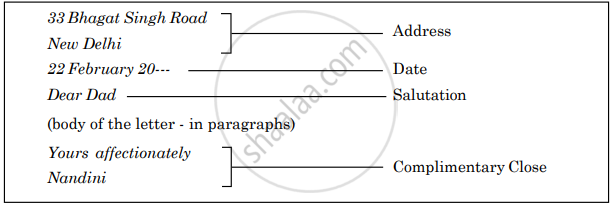
When we write informal letters (to a friend, or to a member of our family), we use this layout.
Some are meet for a maiden's wrist,
Silver and blue as the mountain mist,
Some are flushed like the buds that dream
On the tranquil brow of a woodland stream,
Some are aglow with the bloom that cleaves
To the limpid glory of new born leaves
Read the lines given above and answer the question that follow.
Explain ‘silver and blue as the mountain mist’
Some are Purple and gold flecked grey
For she who has journeyed through life midway,
Whose hands have cherished , whose love has blest,
And cradled fair sons on her faithful breast,
And serves her household in fruitful pride,
And worship the gods at her husband's side.
Read the lines given above and answer the question that follow:
What’kinds of bangles have earlier been mentioned?
An old man with steel rimmed spectacles and very dusty clothes sat by the side of the road. There was a pontoon bridge across the river and carts, trucks, and men, women and children were crossing it. The mule-drawn carts staggered up the steep bank from the bridge with soldiers helping push against the spokes of the wheels. The trucks ground up and away heading out of it all and the peasants plodded along in the ankle deep dust. But the old man sat there without moving. He was too tired to go any farther.
Read the extract given below and answer the question that follow.
Why were the soldiers “helping to push against the spokes of the wheels”?
Easton, with a little laugh, as if amused, was about to speak again when the other forestalled him. The glum-faced man had been watching the girl’s countenance with veiled glances from his keen, shrewd eyes.
“You’ll excuse me for speaking, miss, but, I see you’re acquainted with the marshall here. If you’ll ask him to speak a word for me when we get to the pen he’ll do it, and it’ll make things easier for me there. He’s taking me to Leavenworth prison. It’s seven years for counterfeiting.”
“Oh!” said the girl, with a deep breath and returning color. “So that is what you are doing out here? A marshal!”
“My dear Miss Fairchild,” said Easton, calmly, “I had to do something. Money has a way of taking wings unto itself, and you know it takes money to keep step with our crowd in Washington. I saw this opening in the West, and—well, a marshalship isn’t quite as high a position as that of ambassador, but—”
Read the extract given below and answer the question that follow.
What is the relationship between Mr. Easton and Ms. Fairchild?
But even as he approached the boy, Mr. Oliver sensed that something was wrong. The boy appeared to be crying. His head hung down, he held his face in his hands, and his body shook convulsively. It was a strange, soundless weeping, and Mr. Oliver felt distinctly uneasy.
Well, what’s the matter, he asked, his anger giving way to concern. What are you crying for? The boy would not answer or look up. His body continued to be wracked with silent sobbing.
Oh, come on, boy. You shouldn’t be out here at this hour. Tell me the trouble. Look up.
Read the extract given below and answer the question that follow.
When did Mr Oliver sense that there was something wrong?
Then, trying to hide my nervousness, I added, “How are you?”
“I’m fine. The question is: How are you?“
“What do you mean?” 1 asked “Something must be eating you,” he said—proud the way foreigners are when they’ve mastered a bit of American slang. “You should be able to qualify with your eyes closed.”
“Believe me, I know it,” I told him—and it felt good to say that to someone.
For the next few minutes we talked together. I didn’t tell Long what was “eating” me, but he seemed to understand my anger, and he took pains to reassure me. Although he’d been schooled in the Nazi youth movement, he didn’t believe in the Aryan-supremacy business any more than I did. We laughed over the fact that he really looked the part, though. An inch taller than I, he had a lean, muscular frame, clear blue eyes, blond hair and a strikingly handsome, chiseled face. Finally, seeing that I had calmed down somewhat, he pointed to the take-off board.
“Look,” he said. “Why don’t you draw a line a few inches in back of the board and aim at making your take-off from there? You’ll be sure not to foul, and you certainly ought to jump far enough to qualify. What does it matter if you’re not first in the trials? Tomorrow is what counts.”
Read the extract given below and answer the question that follow.
What was actually eating Jesse Owens?
Discuss the following topic in groups.
“Death in an open field is better than life in a small hut,” Chandni said to herself. Was it the right decision? Give reasons for your answer.
Discuss in small groups
• Has Rukku Manni done exactly the same as the children? In your opinion, then, is it right for one party to blame the other?
We should be friendly towards our neighbours. Why so?
How the author and his friend spent the entire day?
What type of shopkeeper was Mr. Purcell?
Narrate the story of the friendship between the monkey and the crocodile in about 80 words.
What happens to our body when we sleep?
How did Saeeda’s mother feel on that sunny day?
Complete the following sentence.
The small gray squirrel became friendly when _________
What was the real aim of Miss Beam’s school?
Which of the following statements is used by Angelou to describe the caged bird?
