Advertisements
Advertisements
Question
What does the swallow see when it flies over the city?
Advertisements
Solution
When the swallow was flying over the city, it saw the rich making merry and the beggars sitting at the gates of the rich men’s houses. It flew into the dark lanes and saw the white faces of starving children. Under the archway of a bridge, it saw two little boys lying in each other’s arms trying to keep themselves warm in the rain. They were extremely hungry and on top of it, they were asked by the watchman to vacate the archway. The swallow went back and told the Prince about all it had seen.
RELATED QUESTIONS
Expressions used to show fear
Can you find the expressions in the story that tell you that the author was frightened?
Read the story and complete the following sentences.
1. I was turned ______.
2. I sat there holding ______.
3. In the light of the lamp I sat there like ______.
How has Prashant, a teenager, been able to help the people of his village?
Parents alone are responsible for inculcating a good sense of dental hygiene amongst children. Do you agree/disagree? Discuss with your partner.
"My father lived at Blenheim then,
Yon little stream hard by;
They burnt his dwelling to the ground,
And he was forced to fly;
So with his wife and child he fled,
Nor had he where to rest his head.
"With fire and sword the country round
Was wasted far and wide,
And many a childing mother then,
And new-born baby died;
But things like that, you know, must be
At every famous victory;
Read the lines given above and answer the question that follow.
What happened to Kaspar’s family in the war?
The athletes had come from all over the country
To run for the gold, for the silver and bronze
Many weeks and months of training
All coming down to these games.
The spectators gathered around the old field
To cheer on all the young women and men
The final event of the day was approaching
Excitement grew high to begin.
Read the lines given above and answer the following question:
What event is being referred to?
There was a time when our people covered the land as the waves of a wind-ruffled sea cover its shell-paved floor, but that time long since passed away with the greatness of tribes that are now but a mournful memory. 1 will not dwell on, nor mourn over, our untimely decay, nor reproach my paleface brothers with hastening it, as we too may have been somewhat to blame.
Youth is impulsive. When our young men grow angry at some real or imaginary wrong, and disfigure their faces with black paint, it denotes that their hearts are black, and that they are often cruel and relentless, and our old men and old women are unable to restrain them. Thus it has ever been. Thus it was when the white man began to push our forefathers ever westward. But let us hope that the hostilities between us may never return. We would have everything to lose and nothing to gain. Revenge by young men is considered gain, even at the cost of their own lives, but old men who stay at home in times of war, and mothers who have sons to lose, know better.
Read the extract given below and answer the question that follow.
What happened when the tribal young man became angry?
An old man with steel rimmed spectacles and very dusty clothes sat by the side of the road. There was a pontoon bridge across the river and carts, trucks, and men, women and children were crossing it. The mule-drawn carts staggered up the steep bank from the bridge with soldiers helping push against the spokes of the wheels. The trucks ground up and away heading out of it all and the peasants plodded along in the ankle deep dust. But the old man sat there without moving. He was too tired to go any farther.
Read the extract given below and answer the question that follow.
What does the term “pontoon bridge” mean?
Read the extract given below and answer the questions that follow :
Giles: I beg your pardon. Did you say something?
Trotter: Yes, Mr. Ralston, I said ‘Is there an extension ?’ (He crosses to Centre.)
Giles: Yes, up in our bedroom.
Trotter: Go and try it up there for me, will you?
(Giles exits to the stairs, carrying the glove and bus ticket and looking dazed. Trotter continues to trace the wire to the window. He pulls back the curtain and opens the window, trying to follow the wire. He crosses to the arch up Right, goes out and returns with a torch. He moves to the window, jumps out and bends down, looking, then disappears out of sight. It is practically dark. Mrs. Boyle enters from the library up Left, shivers and notices the open window.)
Mrs Boyle: (Moving to the window) Who has left this window open?
(i) Why did Giles fail to hear what Trotter had said earlier·? Why did Giles look 'dazed'?
(ii) What was Trotter attempting to do? Why?
(iii) Why did Mrs. Boyle close the window? What did tl1e voice on the radio say about the 'mechanics of fear'?
(iv) How did the murderer mask the sounds of the killing? Who entered the room immediately after the murder? What did this person see?
(v) Who was the victim? Why was the victim murdered? What was the 'signature tune' that the murderer whistled? What is the significance of this tune in the context of the play?
Did the wise men win the reward? If not, why not?
Discuss in small groups
• If you want to give away something of your own to the needy, would it be better to ask your elders first?
What did the beggar feel about the ladies of the household?
Which line in the poem suggests that you need a keen eye and a sharp ear to enjoy a meadow? Read aloud the stanza that contains this line.
There are twelve words hidden in this table. Six can be found horizontally and the remaining six vertically. All of them are describing words like ‘good’, ‘happy’, etc. The first letters of the words are given below:
Horizontal: H R F F S G
Vertical: A W S F L Q 2020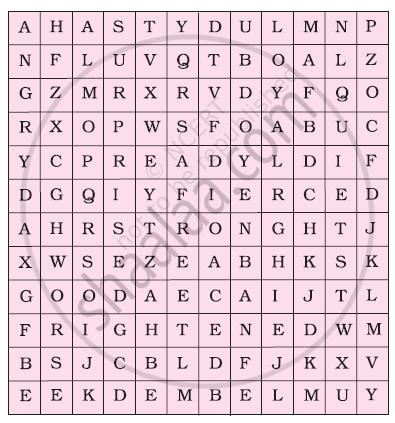
Use the phrase in a sentence of your own, after finding out its meaning.
broke apart
What information about snakes do you get in the lesson Desert Animals?
The words given against the sentences below can be used both as nouns and verbs. Use them appropriately to fill in the blanks.
(i) She has a lovely ____________. (face)
(ii) India ____________ a number of problems these days.
The hawker passes time _________.
Fill in the blanks with the words given in the box.
| how, what, when, where, which |
There are so many toys in the shops. Neena can’t decide ______ one to buy.
Complete the following sentence by providing a reason:
In Act III, Scene II of the play, The Tempest, Stephano threatens to tie Trinculo to the next tree because ______.
Which of the given options contains the figure of speech that appears in the following line from Leigh Hunt's poem “The Glove and the Lions’: ‘Ramped and roared the lions’:
