Advertisements
Advertisements
Question
Mr Wonka collected whose toe-nail?
Advertisements
Solution
Mr Wonka collected the toe-nail clipping of a 168 years old Russian farmer called Petrovitch Gregorovitch.
RELATED QUESTIONS
Who had these opinion about Einstein?
He was a freak.
Why do the courtiers call the prince ‘the Happy Prince’? Is he really happy? What does he see all around him?
Bill Bryson “ached to be suave”. Is he successful in his mission? List his ‘unsuave’ ways.
Read the following passage carefully and answer the questions that follow :
Billy Weaver had travelled down from London, and by the time he arrived, it was nine o’clock in the night, and the moon was coming up.
“Excuse me,” he asked a porter. “But is there a cheap hotel nearby?”
“Try the Bell Hotel,” the porter answered, pointing down the road.
Billy thanked him, picked up his suitcase, and set out to walk the distance to the Bell Hotel. He had never been to Richmond before, but the man at the office had told him it was a splendid city.
Billy was seventeen years old. He was wearing a new navy blue overcoat, a new brown hat, and a new brown suit, and he was feeling fine. He walked briskly down the street. He was trying to do everything briskly these days. The big shots up at the head office were fantastically brisk all the time. They were amazing.
The road was lonely and dark, with a few scattered houses.
Suddenly, in a downstairs window, Billy saw a printed notice propped up against the window glass. It said bed and breakfast.
He moved a bit closer and peered through the window into the room, and the first thing he saw was a bright fire burning in the hearth. On the carpet in front of the fire, a little dog was curled up asleep with its nose tucked into its belly. The room, in its half-darkness, was filled with pleasant furniture. There was a piano, a big sofa, and several plump armchairs. In one corner, he spotted a large parrot in a cage. Animals were usually a good sign in a place like this, Billy told himself, and it looked to him as though it would be a pretty decent house to stay in.
Then a queer thing happened to him. He was in the act of stepping back and going away from the window when he felt a strange urge to ring the bell!
He pressed the bell. He heard it ring, and then, at once, the door swung open, and a woman stood there.
She gave him a warm, welcoming smile.
“Please come in,” she said pleasantly. Billy found himself automatically moving forward into the house.
“I saw the notice in the window,” he said, holding himself back.
“Yes, I know.”
“I was wondering about a room.”
“It’s already for you, my dear,” she said. She had a round, pink face and very gentle blue eyes.
“How much do you charge?”
“Five dollars a night, including breakfast.”
It was fantastically cheap. He could easily afford it.
(a) Give the meaning of the following words used in the passage: One-word answers or short phrases will be accepted. [3]
(i) splendid (line 7)
(ii) spotted (line 20)
(iii) automatically (line 29)
(b) Answer the following questions briefly in your own words.
Reviewing verb forms
In pairs, study the completed sentences in 5 above. You will notice that words like a little and much go with certain nouns. Are these nouns Countable [C] or Uncountable [U]?
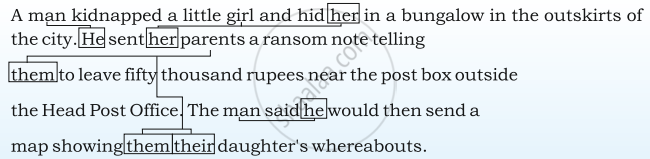
Look at the passage below and study how the personal pronouns refer to different people.
The horse was nearly life-size, moulded out of clay, baked, burnt, and brightly coloured, and reared its head proudly, prancing its forelegs in the air and flourishing its tail in a loop; beside the horse stood a warrior with scythelike mustachios, bulging eyes, and aquiline nose. The old image-makers believed in indicating a man of strength by bulging out his eyes and sharpening his moustache tips, and also decorated the man’s chest with beads which looked today like blobs of mud through the ravages of sun and wind and rain (when it came), but Muni would insist that he had known the beads to sparkle like the nine gems at one time in his life.
Read the extract given below and answer the question that follow.
What was the effect of the construction of the highway?
Mr. Oliver, an Anglo-Indian teacher, was returning to his school late one night on the outskirts of the hill station of Shimla. The school was conducted on English public school lines and the boys – most of them from well-to-do Indian families – wore blazers, caps and ties. “Life” magazine, in a feature on India, had once called this school the Eton of the East.
Mr. Oliver had been teaching in this school for several years. He’s no longer there. The Shimla Bazaar, with its cinemas and restaurants, was about two miles from the school; and Mr. Oliver, a bachelor, usually strolled into the town in the evening returning after dark, when he would take short cut through a pine forest.
Read the extract given below and answer the question that follow.
What did Mr Oliver generally do in the evening?
Lights were shining from every window, and there was a savoury smell of roast goose, for it was New-year’s eve—yes, she remembered that. In a corner, between two houses, one of which projected beyond the other, she sank down and huddled herself together. She had drawn her little feet under her, but she could not keep off the cold; and
she dared not go home, for she had sold no matches, and could not take home even a penny of money. Her father would certainly beat her; besides, it was almost as cold at home as here, for they had only the roof to cover them, through which the wind howled, although the largest holes had been stopped up with straw and rags. Her little hands were almost frozen with the cold. Ah! perhaps a burning match might be some good, if she could draw it from the bundle and strike it against the wall, just to warm her fingers. She drew one out—“scratch!” how it sputtered as it burnt! It gave a warm, bright light, like a little candle, as she held her hand over it. It was really a wonderful light. It seemed to the little girl that she was sitting by a large iron stove, with polished brass feet and a brass ornament. How the fire burned! and seemed so beautifully warm that the child stretched out her feet as if to warm them, when, lo! the flame of the match went out, the stove vanished, and she had only the remains of the half-burnt match in her hand.
Read the extract given below and answer the question that follow.
How did she try to keep herself warm?
What distinction Mr Gessler’s shop had?
What were Soapy’s hopes for the winter?
- What happens if Raga Deepak is sung properly?
- Why did Tansen’s enemies want him to sing the Raga?
There are four pairs of rhyming words in the poem. Say them aloud.
Find these sentences in the story and fill in the blanks.
Find these sentences in the story and fill in the blanks.
(i) This made Taro ___________________ than ever. (3)
(ii) He decided to work ___________________ than before. (3)
(iii) Next morning, Taro jumped out of bed ___________________ than usual. (4)
(iv) He began to chop even ____________________. (4)
(v) Next morning, Taro started for work even _______________ than the morning before. (10)
Read the newspaper report to find the following facts about Columbia’s ill-fated voyage.
Date of return journey: ____________
In groups of four, discuss the following lines and their meanings.
For many of the loveliest things
Have never yet been said
Who says this to whom and why?
“Victory to the panchayat. This is justice.”
Fill in the blanks with the words given in the box.
| how, what, when, where, which |
Do you know ______ to ride a bicycle? I don’t remember ______ and ______ I learnt it
Complete the following sentence by providing a reason:
Towards the end of the poem Birches, the poet expresses a wish to return to Earth because ______.
