Advertisements
Advertisements
Question
Look at the following picture. One asks a question, the other answers it. Then the answer is noted in a form as shown below.
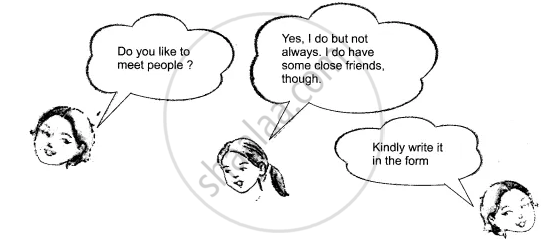
| Questions | Yes/No | Additional Response |
|
1. Do you like to meet people? |
Yes I do, but not always | I do have some close friends, though. |
|
2. Do you like the area you live in? |
No, I Don't | But I have no choice |
Advertisements
Solution
Do it yourself
APPEARS IN
RELATED QUESTIONS
Read this article about the great Indian Rhinoceros. [You will find the information useful for your group discussion in 5.]
The Indian Rhinoceros or the Great One-Horned Rhinoceros or the Asian Onehorned Rhinoceros (Rhinoceros unicomis) is a large mammal primarily found in north-eastern India, Nepal and parts of Bhutan. It is confined to the tall grasslands and forests in the foothills of the Himalayas.
The Indian Rhinoceros once ranged throughout the entire stretch of the Indo Gangetic Plain but excessive hunting reduced their natural habitat drastically.
Today, about 3,000 Indian Rhinos live in the wild, 1,800 of which are found in Assam alone. In 2008, more than 400 Indian Rhinos were sighted in Nepal's Chitwan National Park.
In size it is equal to that of the White Rhino in Africa; together they are the largest of all rhino species. The Great One-Horned Rhinoceros has a single horn; this is present in both males and females, but not on newborn young. In most adults, the horn reachee a length of about 25 centimetres, but has been recorded up to 57 .2 centimetres in length. The nasal hom curves backwards from the nose. The horn is naturally black.
This prehistoric-looking rhinoceros bas thick, silver-brown skin which becomes pinkish near the large skin folds that cover its body. The male develops thick neckfolds. It has very little body hair aside from eyelashes, ear-fringes and tail-brush.
These rhinos live in tall grasslands and riverine forests, but due to the loss of habitat, they have been forced towards cultivated land. They are mostly solitary creatures, with the exception of mothers and calves and breeding pairs, although they sometimes, congregate at bathing areas.

The Indian Rhinoceros makes a wide variety of vocalizations. At least ten distinct vocalizations have been identified: snorting, honking, bleating, roaring, squeak panting, moo-grunting, shrieking, groaning, rumbling and humphing. In addition to noises, the rhino also uses olfactory communication.
In aggregation, Indian Rhinos are often friendly. They will often greet each other by waving or bobbing their heads, mounting flanks, nuzzling noses, or licking. Rhinos will playfully spar, run around, and play with twigs in their mouth. Adult males are the primary instigators of fights. Fights between dominant males are the most common cause of rhino mortality. Indian rhinos have few natural enemies, except for tigers. Tigers sometimes kill unguarded calves, but adult rhinos are less vulnerable due to their size. Humans are the only other animal threat, hunting the rhinoceros primarily for sport or for the use of its horn. Indian Rhinos have been somewhat tamed and trained in circuses, but they remain dangerous and unpredictable animals.
In the nineteenth and early twentieth century, the Indian Rhinoceros was hunted relentlessly. Reports from the middle of the nineteenth century claim that some military officers in Assam individually shot more than 200 rhinos. In the early 1900s, officials became concerned at the rhinos' plummeting numbers. By 1908 in Kaziranga, one of the Rhinos' main ranges, the population had fallen to around 12 individuals. In 1910, all rhino hunting in India became prohibited.
The rhino has been a major success in conservation. Only 100 remained in the early 1900s; a century later, their population has increased to about 2500 again, but even so, the species is still endangered. The Indian rhino is illegally poached for its horn. Some cultures in East Asia believe that the hair has healing and potency powers and therefore is used for traditional Chinese medicine and other Oriental medicines.
The Indian and Nepalese Governments have taken major steps towards Indian Rhinoceros conservation with the help of the World Wildlife Fund (WWF). The Kaziranga National Park and Manas National Park in Assam, Pobitora Reserve Forest in Assam {having the highest Indian rhino density in the world), Orang National Park of Assam, Laokhowa Reserve Forest of Assam (having a very small population) and Royal Chitwan National Park in Nepal are homes to this endangered animal.
The black man's face bespoke revenge
As the fire passed from his sight.
For all he saw in his stick of wood
Was a chance to spite the white.
The last man of this forlorn group
Did nought except for gain.
Giving only to those who gave
Was how he played the game.
Their logs held tight in death's still hands
Was proof of human sin.
They didn't die from the cold without
They died from the cold within.
Read the lines given above and answer the question that follow.
What was the obvious cause of their deaths ?
The black man's face bespoke revenge
As the fire passed from his sight.
For all he saw in his stick of wood
Was a chance to spite the white.
The last man of this forlorn group
Did nought except for gain.
Giving only to those who gave
Was how he played the game.
Their logs held tight in death's still hands
Was proof of human sin.
They didn't die from the cold without
They died from the cold within.
Read the lines given above and answer the question that follow.
What message does the poet want to convey ?
Mr. Oliver, an Anglo-Indian teacher, was returning to his school late one night on the outskirts of the hill station of Shimla. The school was conducted on English public school lines and the boys – most of them from well-to-do Indian families – wore blazers, caps and ties. “Life” magazine, in a feature on India, had once called this school the Eton of the East.
Mr. Oliver had been teaching in this school for several years. He’s no longer there. The Shimla Bazaar, with its cinemas and restaurants, was about two miles from the school; and Mr. Oliver, a bachelor, usually strolled into the town in the evening returning after dark, when he would take short cut through a pine forest.
Read the extract given below and answer the question that follow.
What did Mr Oliver generally do in the evening?
I was in for a surprise. When the time came for the broad-jump trials, I was startled to see a tall boy hitting the pit at almost 26 feet on his practice leaps! He turned out to be a German named Luz Long. 1 was told that Hitler hoped to win the jump with him. I guessed that if Long won, it would add some new support to the Nazis’ “master race” (Aryan superiority) theory. After all, I am a Negro. Angr about Hitler’s ways, 1 determined to go out there and really show Der Fuhrer and his master race who was superior and who wasn’t. An angry athlete is an athlete who will make mistakes, as any coach will tell you. I was no exception. On the first of my three qualifying jumps, I leaped from several inches beyond the takeoff board for a foul. On the second jump, I fouled even worse. “Did I come 3,000 miles for this?” I thought bitterly. “To foul out of the trials and make a fool of myself ?” Walking a few yards from the pit, 1 kicked disgustedly at the dirt.
Read the extract given below and answer the question that follow.
“I was no exception: – Explain.
Tilloo pressed the red button and “the damage was done”. What was the damage?
How was the tiger cub fed?
Why did Tansen agree to sing Raga Deepak?
Describe briefly to the class an improbable dream you have had.
Multiple Choice Question:
According to the poet, a house is ________
List out the action words in the poem.
Dive, dip, snaps, __________, __________, __________, __________, __________
Find out the meanings of these words.
Answer the following question:
What abilities must an astronaut have, according to the journalist?
What did the author point out about the children in the playground?
What did Miss Beam tell the author about the game being played among the friends?
Talk to your partner and say whether the following statement is true or false.
Deserts are endless sand dunes.
Who says this to whom and why?
“What have you to say in your defence?”
Your partner and you may now be able to answer the question.
Like the child in the poem, you perhaps have your own, wishes for yourself. Talk to your friend, using “I wish I were..
Complete the following sentence by providing a reason:
Towards the end of the story B. Wordsworth, the poet told the boy to never visit him because ______.
Complete the following sentence by providing a reason:
In the poem, The Darkling Thrush, the poet thinks the bird had some awareness which the poet did not because ______.
Complete the following sentence by providing a reason.
In the short story, The Cookie Lady, Mrs. Drew wanted Bubber to keep visiting her because ______.
