Advertisements
Advertisements
प्रश्न
Look at the following picture. One asks a question, the other answers it. Then the answer is noted in a form as shown below.
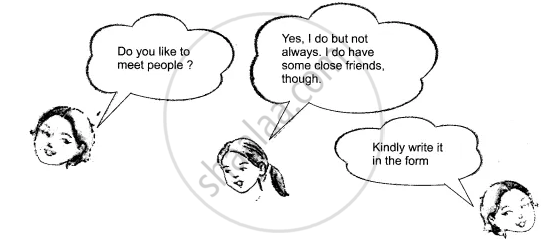
| Questions | Yes/No | Additional Response |
|
1. Do you like to meet people? |
Yes I do, but not always | I do have some close friends, though. |
|
2. Do you like the area you live in? |
No, I Don't | But I have no choice |
Advertisements
उत्तर
Do it yourself
APPEARS IN
संबंधित प्रश्न
The Shehnai of Bismillah Khan Thinking about the text :
Tick the right answer.
Bismillah Khan’s paternal ancestors were (barbers, professional musicians).
Now fill in the blanks with suitable words from the ones that you have formed.
(i) Mass literacy was possible only after the ___________ of the printing machine.
(ii) Ramesh is unable to tackle the situation as he lacks ____________.
(iii) I could not resist the _____________ to open the letter.
(iv) Hardwork and ___________are the main keys to success.
(v) The children were almost fainting with ______________after being made to stand in the sun.
Thinking about the Poem
Is the poet now a child? Is his mother still alive?
Does everybody have a cosy bed to lie in when it rains? Look around you and describe how different kinds of people or animals spend time, seek shelter etc. during rain.
On the basis of your understanding of the poem, answer the following question
by ticking the correct choice.
'The Solitary Reaper' is a narrative poem set to music. This form of verse is called
a______.
Listen to this extract from Shakespeare's play As You Like It. As you listen, read
the poem aloud; you can do this more than once.
All the world's a stage
And all the men and women merely players:
They have their exits and their entrances;
And one man in his time plays many parts,
His acts being seven ages. At first the infant,
Mewling and puking in the nurse's arms.
Then the whining schoolboy, with his satchel
And shining morning face, creeping like snail
Unwillingly to school. And then the lover,
Sighing like furnace, with a woeful ballad
Made to his mistress' eyebrow. Then a soldier.
Full of strange oaths, and bearded like the pard,
Jealous in honour, sudden and quick in quarrel,
Seeking the bubble reputation.
Even in the cannon's mouth. And then the justice,
In fair round belly with good capon lined,
With eyes severe and beard of formal cut,
Full of wise saws and modern instances;
And so he plays his part. The sixth age shifts
Into the lean and slippered pantaloon,
With spectacles on nose and pouch on side,
His youthful hose, well saved, a world too wide
For his shrunk shank; and his big manly voice,
Turning again toward childish treble, pipes
And whistles in his sound. Last scene of all,
That ends this strange eventful history,
Is second childishness and mere oblivion,
Sans teeth, sans eyes, sans taste, sans everything.
About the Poet
William Shakespeare (1564-1616) was born in Stratford-upon-Avon. He is
considered by many to be the greatest dramatist of all time. He wrote 154 sonnets, two
long narrative poems and about three dozen plays. Shakespeare used poetic and
dramatic means to create unified aesthetic effects. In verse, he perfected the dramatic
blank verse.
'All right!' you 'll cry.'All right!' you'll say,
'But if we take the set away,
What shall we do to entertain
Our darling children?Please explain!'
We'll answer this by asking you,
'What used the darling ones to do?
'How used they keep themselves contented
Before this monster was invented?'
Have you forgotten? Don't you know?
We'll say it very loud and slow:
THEY ... USED ... TO ... READ! They'd READ and READ,
AND READ and READ, and then proceed
To READ some more. Great Scott! Gadzooks!
One half their lives was reading books!
The nursery shelves held books galore!
Books cluttered up the nursery floor!
And in the bedroom, by the bed,
More books were waiting to be read!
Read the lines given above and answer the question given below.
Explain with reference to context.
The horse was nearly life-size, moulded out of clay, baked, burnt, and brightly coloured, and reared its head proudly, prancing its forelegs in the air and flourishing its tail in a loop; beside the horse stood a warrior with scythelike mustachios, bulging eyes, and aquiline nose. The old image-makers believed in indicating a man of strength by bulging out his eyes and sharpening his moustache tips, and also decorated the man’s chest with beads which looked today like blobs of mud through the ravages of sun and wind and rain (when it came), but Muni would insist that he had known the beads to sparkle like the nine gems at one time in his life.
Read the extract given below and answer the question that follow.
What was the effect of the construction of the highway?
The boy looked up. He took his hands from his face and looked up at his teacher. The light from Mr. Oliver’s torch fell on the boy’s face, if you could call it a face. He had no eyes, ears, nose or mouth. It was just a round smooth head with a school cap on top of it.
And that’s where the story should end, as indeed it has for several people who have had similar experiences and dropped dead of inexplicable heart attacks. But for Mr. Oliver, it did not end there. The torch fell from his trembling hand. He turned and scrambled down the path, running blindly through the trees and calling for help. He was still running towards the school buildings when he saw a lantern swinging in the middle of the path. Mr. Oliver had never before been so pleased to see the night watchman. He stumbled up to the watchman, gasping for breath and speaking incoherently.
What is it, Sahib? Asked the watchman, has there been an accident? Why are you running?
I saw something, something horrible, a boy weeping in the forest and he had no face.
No face, Sahib?
No eyes, no nose, mouth, nothing.
Do you mean it was like this, Sahib? asked the watchman, and raised the lamp to his own face. The watchman had no eyes, no ears, no features at all, not even an eyebrow. The wind blew the lamp out and Mr. Oliver had his heart attack.
Read the extract given below and answer the question that follow.
What did the watchman ask Mr Oliver? ‘
Joe did not see the Guardians of the Poor on that day, on the next, nor on the day following. In fact, he never saw them at all on Maggie’s account, for in less than a week Mrs. Joe Thompson would as soon leave thought of taking up her own abode in the almshouse as sending Maggie there.
What light and blessing did that sick and helpless child bring to the home of Joe Thompson, the poor wheelwright! It had been dark, and cold, and miserable there for a long time just because his wife had nothing to love and care for out of herself, and so became soar, irritable, ill-tempered, and self-afflicting in the desolation of her woman’s nature. Now the sweetness of that sick child, looking ever to her in love, patience, and gratitude, was as honey to her soul, and she carried her in her heart as well as in her arms, a precious burden. As for Joe Thompson, there was not a man in all the neighbourhood who drank daily of a more precious wine of life than he. An angel had come into his house, disguised as a sick, helpless, and miserable child, and filled all its dreary chambers with the sunshine of love.
Read the extract given below and answer the question that follow.
What had changed Mrs Thompson?
Answer the following question.
What did the crocodile do to show that it was a real crocodile?
Discuss the following topic in groups
Most people keep dogs and cats as pets. Can you think of some unusual pets that people keep?
Complete the following sentence.
Ravi compares Lalli’s playing the violin to ________________.
Read the following sentences.
a) If she knows we have a cat, Paati will leave the house.
(b) She won’t be so upset if she knows about the poor beggar with sores on his feet.
c) If the chappals do fit, will you really not mind? Notice that each sentence consists of two parts. The first part begins with ‘if’. It is known as if-clause.
Rewrite each of the following pairs of sentences as a single sentence. Use ‘if’ at the beginning of the sentence
Work hard. You’ll pass the examination in the first division
What happened when the wicked old farmer sprinkled ash over the cherry tree?
Why has sleep been called a wonder?
Who really helped Vijay Singh in defeating the ghost? How?
Answer the following question.
Why was Algu upset over Jumman’s nomination as head Panch?
The words helper, companion, partner and accomplice have very similar meanings, but each word is typically used in certain phrases. Can you fill in the blanks below with the most commonly used words? A dictionary may help you.
his …………….. in his criminal activities.
What role does Ariel play in Act IV of the play, The Tempest?
