Advertisements
Advertisements
प्रश्न
Look at the following picture. One asks a question, the other answers it. Then the answer is noted in a form as shown below.
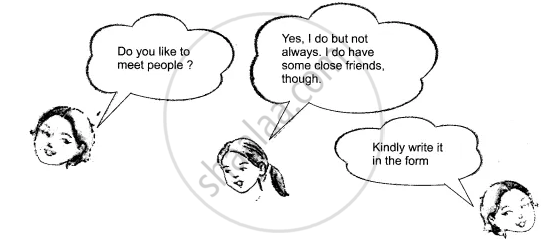
| Questions | Yes/No | Additional Response |
|
1. Do you like to meet people? |
Yes I do, but not always | I do have some close friends, though. |
|
2. Do you like the area you live in? |
No, I Don't | But I have no choice |
Advertisements
उत्तर
Do it yourself
APPEARS IN
संबंधित प्रश्न
Thinking about the Poem
What does the poet like to do when it rains?
A Russian girl, Maria Sharapova, reached the summit of women’s tennis when she was barely eighteen. As you read about her, see if you can draw a comparison between her and Santosh Yadav.
Match the following.
| something disarming | something that makes you feel friendly, taking away your suspiciousness |
| at odds with | in contrast to; not agreeing with |
| glamorous attire | attractive and exciting clothes |
| in almost no time | quickly, almost immediately |
| poised beyond her years | more calm, confident and in control than people of her age usually are |
| packed off | sent off |
| launched | started |
| heart wrenching | causing strong feelings of sadness |
Read the English folktale given below and fill up the blank spaces with suitable words.
There were once three tortoises – a father, a mother (a) ________. a baby (b) ________ one fine morning during Spring, they decided (c) ________ picnic. They picked the place (d) ________ they would go; a nice wood at some distance, (e) ________ they began to put their things together. They got tins of cheese, vegetables, meat and fruit preserves. In about three months, they were ready. They set out carrying their baskets (f) ________ eighteen months, they sat down for a rest. They knew (g) ________ they were already half way to the picnic place.
In three years they reached there. They unpacked (h) ________ spread out the canned food. Then, mother began to search inside the basket. She turned it upside down and shook it (i) ________ something important was missing.
“We’ve forgotten the tin-opener. Baby, you’ll have to go back. We can’t start without a tin-opener. We’ll wait for you”. .
“Do you promise (j) ________ you won’t touch a thing (k) ________ I come back?”
“Yes, we promise faithfully,” Mother and father said together.
Soon after, he was lost among the bushes.
So, they waited and waited. A year went by and they were getting hungry. They had promised (l) ________ they waited. They began to feel really hungry (m) ________ the sixth year was about to end.
Mother tortoise said, “He’d never know the difference.” “No,” said the father tortoise.
Mother tortoise said, “He ought to be back by now. Let’s just have one sandwich (n) ________ we are waiting.”
They picked up the sandwiches, (o) ________ as they were going to eat them, a little voice said, “Aha! I knew you’d cheat! It’s a good thing I didn’t start for that tin opener,” baby Tortoise said.
The black man's face bespoke revenge
As the fire passed from his sight.
For all he saw in his stick of wood
Was a chance to spite the white.
The last man of this forlorn group
Did nought except for gain.
Giving only to those who gave
Was how he played the game.
Their logs held tight in death's still hands
Was proof of human sin.
They didn't die from the cold without
They died from the cold within.
Read the lines given above and answer the question that follow.
Discuss personification as used by the poet.
Some are meet for a maiden's wrist,
Silver and blue as the mountain mist,
Some are flushed like the buds that dream
On the tranquil brow of a woodland stream,
Some are aglow with the bloom that cleaves
To the limpid glory of new born leaves
Read the lines given above and answer the question that follow.
To what are the bangles compared?
Old Kaspar took it from the boy,
Who stood expectant by;
And then the old man shook his head,
And,with a natural sigh,
"Tis some poor fellow's skull," said he,
"Who fell in the great victory.
"I find them in the garden,
For there's many here about;
And often when I go to plough,
The ploughshare turns them out!
For many thousand men,"said he,
"Were slain in that great victory."
Read the lines given above and answer the question that follow.
What did Kasper say?
The most important thing we've learned,
So far as children are concerned,
Is never, NEVER, NEVER let
Them near your television set-----
Or better still, just don't install
The Idiotic thing at all.
In almost every house we've been,
we've watched them gaping at the screen
They loll and slop and lounge about,
And stare until their eyes pop out.
(Last week in someone's place we saw
A dozen eyeballs on the floor.
They sit and stare and stare and sit
Until they're hypnotised by it,
Until they're absolutely drunk
With all that shocking ghastly junk.
Read the lines given above and answer the question given below.
What is the most important thing that the poet has learnt?
We will ponder your proposition and when we decide we will let you know. But should we accept it, I here and now make this condition that we will not be denied the privilege without molestation of visiting at any time the tombs of our ancestors, friends, and children. Every part of this soil is sacred in the estimation of my people. Every hillside, every valley, every plain and grove, has been hallowed by some sad or happy event in days long vanished. Even the rocks, which seem to be dumb and dead as the swelter in the sun along the silent shore, thrill with memories of stirring events connected with the lives of my people, and the very dust upon which you now stand responds more lovingly to their footsteps than yours, because it is rich with the blood of our ancestors, and our bare feet are conscious of the sympathetic touch. Our departed braves, fond mothers, glad, happy hearted maidens, and even the little children who lived here and rejoiced here for a brief season, will love these somber solitudes and at eventide they greet shadowy returning spirits. And when the last Red Man shall have perished, and the memory of my tribe shall have become a myth among the White Men, these shores will swarm with the invisible dead of my tribe^ and when your children’s children think themselves alone in the field, the store, the shop, upon the highway, or in the silence of the pathless woods, they will not be alone. In all the earth there is no place dedicated to solitude. At night when the streets of your cities and villages are silent and you think them deserted, they will throng with the returning hosts’that once filled them and still lover this beautiful land. The White Man will never be alone.
Let him be just and deal kindly with my people, for the dead are not powerless. Dead, did I say? There is no death, only a change of worlds.
Read the extract given below and answer the question that follow.
What does the speaker say about death? Explain.
“If you are rested I would go,” I urged. “Get up and try to walk now.”
“Thank you,” he said and got to his feet, swayed from side to side and then sat down backwards in the dust.
“I was taking care of animals,” he said dully, but no longer to me. “I was only taking care of animals.”
There was nothing to do about him. It was Easter Sunday and the Fascists were advancing toward the Ebro. It was a grey overcast day with a low ceiling so their planes were not up. That and the fact that cats know how to look after themselves was all the good luck that the old man would ever have.
Read the extract given below and answer the question that follow.
When the narrator spoke to the old man about the pigeon cage, what does this reveal about him?
Analyze the character of Luz Long.
What three things did Gopal do before he went to buy his hilsa-fish?
"Here comes someone running". Who has been referred to in this sentence?
Do you think we should help people in need? Why so?
Name the narrator in the lesson ‘Expert Detectives’.
If you were a baby crocodile, would you tell Makara that he was wrong? What would you say to convince him?
Read the newspaper report to find the following facts about Columbia’s ill-fated voyage.
Number of astronauts on board: ____________
How did the old aunt get justice?
Give a synonym for ‘like’ in the context of the poem.
The Medicine Bag traces the narrator’s attitude to his Sioux Grandfather, from mild embarrassment to appreciation. Summarise the reasons for this embarrassment and the change. Write your answer in 100-150 words incorporating the following details.
- Reasons for embarrassment
- Specific reasons for the change in attitude
