Advertisements
Advertisements
Question
Read the following sentences.
(a) If she knows we have a cat, Paati will leave the house.
(b) She won’t be so upset if she knows about the poor beggar with sores on his feet
(c) If the chappals do fit, will you really not mind?
Notice that each sentence consists of two parts. The first part begins with ‘if’. It is known as if-clause.
Rewrite each of the following pairs of sentences as a single sentence. Use ‘if’ at the beginning of the sentence
Study regularly. You’ll do well in the examination
Advertisements
Solution
If you study regularly, you’ll do well in the examination.
RELATED QUESTIONS
Thinking about the Text
Answer these question.
You’ll soon stop being smart.”
(i) Who says this?
(ii) Why does the speaker say it?
(iii) What according to the speaker will stop Gerrard from being smart?
Look at the words the poet uses to describe what he sees and hears at Innisfree
- Bee-loud glade
- Evenings full of the linnet’s wings
- Lake water lapping with low sounds
What pictures do these words create in your mind?
On the basis of your understanding of the poem, answer the following question
by ticking the correct choice.
In the poem, a traveller comes to a fork in the road and needs to decide which way to go
to continue his journey. Figuratively the choice of the road denotes
______________________
In line 35, the poet has misspelt the word ‘amalgum’. Why do you think she has done that? Discuss.
Understanding determiners.
Determiners are words that are used in front of nouns to indicate whether you are
referring to something specific or something of a particular type.
Singular nouns always need a determiner. In plural nouns, the determiner is
optional. Determiners may or may not be used with uncountable nouns depending
on context.
There are about 50 different determiners in the English language which include:
Articles: a, an, the
Possessives: my, your, our, their, his, hers, whose, etc.
Demonstratives: this, that these, those, which, etc.
Quantifiers: few, a few, many, much, each, every, some, any, etc.
Number: one, two, three, twenty, forty, etc.
Ordinals: first, second, last, next, etc.
Determiners are used
• to state the unit/ number of people, things or other nouns.
• to state possessives.
• to specify someone or something.
• to state how things or people are distributed.
• to state the difference between nouns.
Determiners can be classified under the following categories:
| EXAMPLES | ||
| MULTIPLIERS | double, twice, three times... | We want double portions. |
| FRACTIONS | half, a third, two fifths ..... | I drove at half speed. |
| INTENSIFIERS | What! Such! | Such impudence! |
| QUANTIFIERS | all, both, most | I like most people. |
| ARTICLES | a, an, the | Get a book from the shelf. |
| DEMONSTRATIVES | this, that, these, those, another, other | That tree is in another garden. |
| DISTRIBUTIVES | each, every, either, neither | I have a gift for each person. |
| POSSESSIVES | ||
| (i) PRONOMINAL | my, your, his, her, its, our, your, their | You can borrow Kim's video. |
| (ii) NOMINAL | Renata's, Adam's, People's ... | You can borrow my video. |
| INTERROGATIVES | What? Which? Whose? | Whose book is that? |
| QUANTIFIERS | some, any, no | I have no problem with them. |
| CARDINAL NUMBERS | one, two, three hundred ..... | Two heads are better than one. |
| ORDINAL NUMBERS | first, fewer, much, more, less, least ......... . | It was my first tennis match. |
| QUANTIFIERS | ||
| (i) SIMPLE | few, fewer, much, more, less, least ........... . |
I have few pals; Kim has more. |
| (ii) COMPOUND | a little, a lot of, a great deal of .... |
I have lots of time to spare. |
This is a meeting of the school’s Parent-Teacher Association. Some student representatives have also been invited to participate to discuss the role that Information technology/computers play in the growth and development of children.
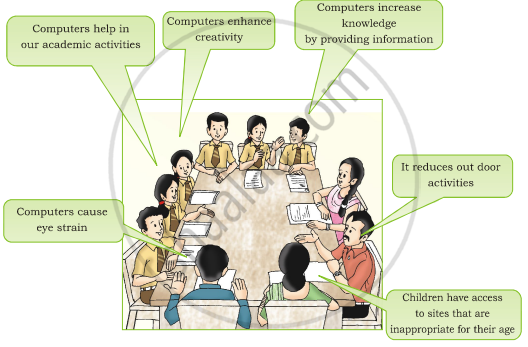
Read and enjoy :
Hockey 
Do you know when hockey was first played? Research in Ethiopia has discovered that it has been around for more than four millenia. A tablet in Greece has images of young people playing field hockey. Even in South America, Ireland, Egypt, Scotland and Rome, there are proofs and records of this game. The game in these countries was no different than the other even though it was known by different names. Hundreds of years ago, this game was known as 'Hockie' in Ireland and it is this name that has stuck with the game ever since.

While current field hockey appeared in the mid-18th century in England, primarily in schools, it was not until the first half of the 19th century that it became firmly established. Prior to 1980, women were not permitted to take part in this game. The first club was created in 1849 at Blackheath in south-east London. During the 1600s and 1700s, hockey in England was a little dissimilar and it was more disorganised. People from all over the village would take part in the game. It was not unusual for a team to have 60 - 100 players. It was the goal of the team players to get the ball into the common ground of the rival team. This game required quite a few days to finish. Many players suffered injuries. Even though umpires were present, they were not allowed to say anything without the team members' request.
Ultimaty , good judgment prevailed. Firm regulations were introduced. In England, a headmaster restricted the number of players to thirty for one single team, During the 1860s, England's Eton College laid down some rules for the game. Additional rules were introduced afterthe formation of the Hockey Association in the year 1875.
Football
Football refers to a number of similar team sports, all of which involve (to varying degrees) kicking a ball with the foot in an attempt to score a goal. People from around the world have played games which involved kicking and / or canying a ball, since ancient times. However, most of the modern codes of football have their origins in England.

The most popular of these sports worldwide is association football, more comm.only known as just 'Football' or 'Soccer'. It is widely considered to be the most popular sport in the world
Some are Purple and gold flecked grey
For she who has journeyed through life midway,
Whose hands have cherished , whose love has blest,
And cradled fair sons on her faithful breast,
And serves her household in fruitful pride,
And worship the gods at her husband's side.
Read the lines given above and answer the question that follow:
What hues of bangles are cherished by a bride ? What are they symbolic of?
“There were three animals altogether,” he explained. “There were two goats and a cat and then there were four pairs of pigeons.”
“And you had to leave them?” I asked.
“Yes. Because of the artillery. The captain told me to go because of the artillery.” “And you have no family?” I asked, watching the far end of the bridge where a few last carts were hurrying down the slope of the bank.
“No,” he said, “only the animals I stated. The cat, of course, will be all right. A cat can look out for itself, but I cannot think what will become of the others.”
“What politics have you?” I asked.
“I am without politics,” he said. “I am seventy-six years old. I have come twelve kilometers now and I think now I can go no further.”
“This is not a good place to stop,” I said. “If you can make it, there are trucks up the road where it forks for Tortosa.”
“I will wait a while,” he said, “ and then I will go. Where do the trucks go?” “Towards Barcelona,” I told him.
“I know no one in that direction,” he said, “but thank you very much.
Read the extract given below and answer the question that follow.
Why did the soldier tell the old man that it was not a good place to stop?
Why did Abbu Khan’s goats want to run away? What happened to them in the hills?
Explain with an example how can you put out fire by cutting the supply of oxygen.
Which ways did Soapy try to reach the prison in vain?
What impressed the king when he spent a night in the cave?
Find these sentences in the story and fill in the blanks.
Find these sentences in the story and fill in the blanks.
(i) This made Taro ___________________ than ever. (3)
(ii) He decided to work ___________________ than before. (3)
(iii) Next morning, Taro jumped out of bed ___________________ than usual. (4)
(iv) He began to chop even ____________________. (4)
(v) Next morning, Taro started for work even _______________ than the morning before. (10)
Why did the speaker find the old banyan tree exclusively his own?
What did the speaker do while hiding himself in the banyan tree branches?
Why did Jumman Shaikh and Algu Chowdhry, the two good friends, become sworn enemies?
Why do rebels always contradict the others?
How did the spirit of the dog help the farmer first?
How did it help him next?
| Caliban: |
No noise, and enter |
In the above lines taken from Act IV Scene i of the play, The Tempest, what does Caliban refer to by the phrase “good mischief“?
