Advertisements
Advertisements
Question
Let \[\vec{A} \text { and } \vec{B}\] be the two vectors of magnitude 10 unit each. If they are inclined to the X-axis at angle 30° and 60° respectively, find the resultant.
Advertisements
Solution
Angle between \[\vec{A} \text { and } \vec{B}\],θ = 60° − 30° = 30°
\[\left| \vec{A} \right| = \left| \vec{B} \right| = 10 \text { units }\]
The magnitude of the resultant vector is given by
\[R = \sqrt{A^2 + A^2 + 2AA\cos\theta}\]
\[ = \sqrt{{10}^2 + {10}^2 + 2 \times 10 \times 10 \times \cos 30^\circ}\]
= `sqrt(100 + 100 + 200 + sqrt3/2)`
= `sqrt(200 +100 xx sqrt3)`
= `sqrt(200 + 173)`
= `sqrt373`
= 19.3
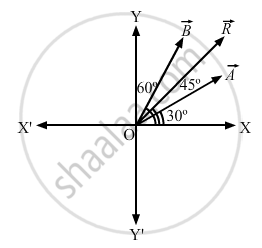
Let β be the angle between
\[\vec{R} \text { and } \vec{A}\].
\[\therefore \beta = \tan^{- 1} \left( \frac{A \sin 30^\circ}{A + A \cos 30^\circ} \right)\]
\[ \Rightarrow \beta = \tan^{- 1} \left( \frac{10 \sin 30^\circ}{10 + 10 \cos 30^\circ} \right)\]
`beta = tan^(-1) (10 xx 1/2)/(10 + 10 xx (sqrt3)/2)`
`beta = tan^(-1) 5/(5(2 + sqrt3))`
`beta = tan^(-1) (1/(2 + sqrt3))`
\[ \Rightarrow \beta = \tan^{- 1} = 15^\circ\]
Angle made by the resultant vector with the X-axis = 15° + 30° = 45°
∴ The magnitude of the resultant vector is 19.3, and it makes an angle of 45° with the X-axis.
APPEARS IN
RELATED QUESTIONS
Some of the most profound statements on the nature of science have come from Albert Einstein, one of the greatest scientists of all time. What do you think did Einstein mean when he said : “The most incomprehensible thing about the world is that it is comprehensible”?
What are the dimensions of the ratio of the volume of a cube of edge a to the volume of a sphere of radius a?
If all the terms in an equation have same units, is it necessary that they have same dimensions? If all the terms in an equation have same dimensions, is it necessary that they have same units?
A physical quantity is measured and the result is expressed as nu where u is the unit used and n is the numerical value. If the result is expressed in various units then
A unitless quantity
Choose the correct statements(s):
Find the dimensions of Planck's constant h from the equation E = hv where E is the energy and v is the frequency.
Let x and a stand for distance. Is
\[\int\frac{dx}{\sqrt{a^2 - x^2}} = \frac{1}{a} \sin^{- 1} \frac{a}{x}\] dimensionally correct?
Let \[\vec{A} = 3 \vec{i} + 4 \vec{j}\]. Write a vector \[\vec{B}\] such that \[\vec{A} \neq \vec{B}\], but A = B.
A vector \[\vec{A}\] points vertically upward and \[\vec{B}\] points towards the north. The vector product \[\vec{A} \times \vec{B}\] is
The radius of a circle is stated as 2.12 cm. Its area should be written as
The x-component of the resultant of several vectors
(a) is equal to the sum of the x-components of the vectors of the vectors
(b) may be smaller than the sum of the magnitudes of the vectors
(c) may be greater than the sum of the magnitudes of the vectors
(d) may be equal to the sum of the magnitudes of the vectors.
A vector \[\vec{A}\] makes an angle of 20° and \[\vec{B}\] makes an angle of 110° with the X-axis. The magnitudes of these vectors are 3 m and 4 m respectively. Find the resultant.
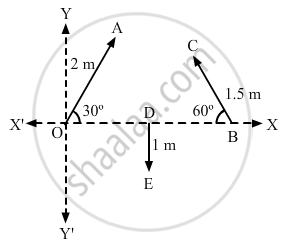
Refer to figure (2 − E1). Find (a) the magnitude, (b) x and y component and (c) the angle with the X-axis of the resultant of \[\overrightarrow{OA}, \overrightarrow{BC} \text { and } \overrightarrow{DE}\].
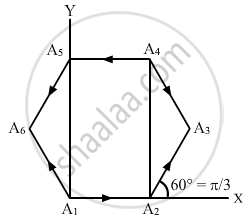
Let A1 A2 A3 A4 A5 A6 A1 be a regular hexagon. Write the x-components of the vectors represented by the six sides taken in order. Use the fact the resultant of these six vectors is zero, to prove that
cos 0 + cos π/3 + cos 2π/3 + cos 3π/3 + cos 4π/3 + cos 5π/3 = 0.
Use the known cosine values to verify the result.
A curve is represented by y = sin x. If x is changed from \[\frac{\pi}{3}\text{ to }\frac{\pi}{3} + \frac{\pi}{100}\] , find approximately the change in y.
The electric current in a charging R−C circuit is given by i = i0 e−t/RC where i0, R and C are constant parameters of the circuit and t is time. Find the rate of change of current at (a) t = 0, (b) t = RC, (c) t = 10 RC.
