Advertisements
Advertisements
प्रश्न
Let \[\vec{A} \text { and } \vec{B}\] be the two vectors of magnitude 10 unit each. If they are inclined to the X-axis at angle 30° and 60° respectively, find the resultant.
Advertisements
उत्तर
Angle between \[\vec{A} \text { and } \vec{B}\],θ = 60° − 30° = 30°
\[\left| \vec{A} \right| = \left| \vec{B} \right| = 10 \text { units }\]
The magnitude of the resultant vector is given by
\[R = \sqrt{A^2 + A^2 + 2AA\cos\theta}\]
\[ = \sqrt{{10}^2 + {10}^2 + 2 \times 10 \times 10 \times \cos 30^\circ}\]
= `sqrt(100 + 100 + 200 + sqrt3/2)`
= `sqrt(200 +100 xx sqrt3)`
= `sqrt(200 + 173)`
= `sqrt373`
= 19.3
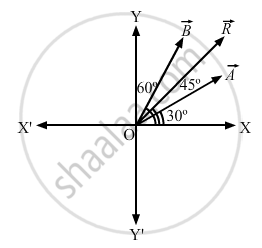
Let β be the angle between
\[\vec{R} \text { and } \vec{A}\].
\[\therefore \beta = \tan^{- 1} \left( \frac{A \sin 30^\circ}{A + A \cos 30^\circ} \right)\]
\[ \Rightarrow \beta = \tan^{- 1} \left( \frac{10 \sin 30^\circ}{10 + 10 \cos 30^\circ} \right)\]
`beta = tan^(-1) (10 xx 1/2)/(10 + 10 xx (sqrt3)/2)`
`beta = tan^(-1) 5/(5(2 + sqrt3))`
`beta = tan^(-1) (1/(2 + sqrt3))`
\[ \Rightarrow \beta = \tan^{- 1} = 15^\circ\]
Angle made by the resultant vector with the X-axis = 15° + 30° = 45°
∴ The magnitude of the resultant vector is 19.3, and it makes an angle of 45° with the X-axis.
APPEARS IN
संबंधित प्रश्न
“Every great physical theory starts as a heresy and ends as a dogma”. Give some examples from the history of science of the validity of this incisive remark
India has had a long and unbroken tradition of great scholarship — in mathematics, astronomy, linguistics, logic and ethics. Yet, in parallel with this, several superstitious and obscurantistic attitudes and practices flourished in our society and unfortunately continue even today — among many educated people too. How will you use your knowledge of science to develop strategies to counter these attitudes ?
“It is more important to have beauty in the equations of physics than to have them agree with experiments”. The great British physicist P. A. M. Dirac held this view. Criticize this statement. Look out for some equations and results in this book which strike you as beautiful.
What are the dimensions of volume of a sphere of radius a?
Suggest a way to measure the thickness of a sheet of paper.
A unitless quantity
Choose the correct statements(s):
(a) All quantities may be represented dimensionally in terms of the base quantities.
(b) A base quantity cannot be represented dimensionally in terms of the rest of the base quantities.
(c) The dimensions of a base quantity in other base quantities is always zero.
(d) The dimension of a derived quantity is never zero in any base quantity.
Find the dimensions of linear momentum .
Find the dimensions of electric field E.
The relevant equations are \[F = qE, F = qvB, \text{ and }B = \frac{\mu_0 I}{2 \pi a};\]
where F is force, q is charge, v is speed, I is current, and a is distance.
Find the dimensions of magnetic field B.
The relevant equation are \[F = qE, F = qvB, \text{ and }B = \frac{\mu_0 I}{2 \pi a};\]
where F is force, q is charge, v is speed, I is current, and a is distance.
Find the dimensions of the specific heat capacity c.
(a) the specific heat capacity c,
(b) the coefficient of linear expansion α and
(c) the gas constant R.
Some of the equations involving these quantities are \[Q = mc\left( T_2 - T_1 \right), l_t = l_0 \left[ 1 + \alpha\left( T_2 - T_1 \right) \right]\] and PV = nRT.
Test if the following equation is dimensionally correct:
\[V = \frac{\pi P r^4 t}{8 \eta l}\]
where v = frequency, P = pressure, η = coefficient of viscosity.
Let \[\vec{A} = 3 \vec{i} + 4 \vec{j}\]. Write a vector \[\vec{B}\] such that \[\vec{A} \neq \vec{B}\], but A = B.
Let \[\vec{C} = \vec{A} + \vec{B}\]
A spy report about a suspected car reads as follows. "The car moved 2.00 km towards east, made a perpendicular left turn, ran for 500 m, made a perpendicular right turn, ran for 4.00 km and stopped". Find the displacement of the car.
Let \[\vec{a} = 2 \vec{i} + 3 \vec{j} + 4 \vec{k} \text { and } \vec{b} = 3 \vec{i} + 4 \vec{j} + 5 \vec{k}\] Find the angle between them.
A curve is represented by y = sin x. If x is changed from \[\frac{\pi}{3}\text{ to }\frac{\pi}{3} + \frac{\pi}{100}\] , find approximately the change in y.
Write the number of significant digits in (a) 1001, (b) 100.1, (c) 100.10, (d) 0.001001.
Round the following numbers to 2 significant digits.
(a) 3472, (b) 84.16. (c)2.55 and (d) 28.5
