Advertisements
Advertisements
प्रश्न
Let \[\vec{A} \text { and } \vec{B}\] be the two vectors of magnitude 10 unit each. If they are inclined to the X-axis at angle 30° and 60° respectively, find the resultant.
Advertisements
उत्तर
Angle between \[\vec{A} \text { and } \vec{B}\],θ = 60° − 30° = 30°
\[\left| \vec{A} \right| = \left| \vec{B} \right| = 10 \text { units }\]
The magnitude of the resultant vector is given by
\[R = \sqrt{A^2 + A^2 + 2AA\cos\theta}\]
\[ = \sqrt{{10}^2 + {10}^2 + 2 \times 10 \times 10 \times \cos 30^\circ}\]
= `sqrt(100 + 100 + 200 + sqrt3/2)`
= `sqrt(200 +100 xx sqrt3)`
= `sqrt(200 + 173)`
= `sqrt373`
= 19.3
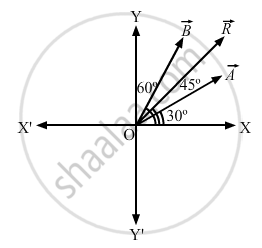
Let β be the angle between
\[\vec{R} \text { and } \vec{A}\].
\[\therefore \beta = \tan^{- 1} \left( \frac{A \sin 30^\circ}{A + A \cos 30^\circ} \right)\]
\[ \Rightarrow \beta = \tan^{- 1} \left( \frac{10 \sin 30^\circ}{10 + 10 \cos 30^\circ} \right)\]
`beta = tan^(-1) (10 xx 1/2)/(10 + 10 xx (sqrt3)/2)`
`beta = tan^(-1) 5/(5(2 + sqrt3))`
`beta = tan^(-1) (1/(2 + sqrt3))`
\[ \Rightarrow \beta = \tan^{- 1} = 15^\circ\]
Angle made by the resultant vector with the X-axis = 15° + 30° = 45°
∴ The magnitude of the resultant vector is 19.3, and it makes an angle of 45° with the X-axis.
APPEARS IN
संबंधित प्रश्न
If two quantities have same dimensions, do they represent same physical content?
It is desirable that the standards of units be easily available, invariable, indestructible and easily reproducible. If we use foot of a person as a standard unit of length, which of the above features are present and which are not?
Suggest a way to measure the thickness of a sheet of paper.
The dimensions ML−1 T−2 may correspond to
Choose the correct statements(s):
(a) All quantities may be represented dimensionally in terms of the base quantities.
(b) A base quantity cannot be represented dimensionally in terms of the rest of the base quantities.
(c) The dimensions of a base quantity in other base quantities is always zero.
(d) The dimension of a derived quantity is never zero in any base quantity.
Find the dimensions of pressure.
Test if the following equation is dimensionally correct:
\[v = \sqrt{\frac{P}{\rho}},\]
where v = velocity, ρ = density, P = pressure
Test if the following equation is dimensionally correct:
\[v = \frac{1}{2 \pi}\sqrt{\frac{mgl}{I}};\]
where h = height, S = surface tension, \[\rho\] = density, P = pressure, V = volume, \[\eta =\] coefficient of viscosity, v = frequency and I = moment of interia.
Is a vector necessarily changed if it is rotated through an angle?
Can you add three unit vectors to get a unit vector? Does your answer change if two unit vectors are along the coordinate axes?
Let \[\vec{A} = 3 \vec{i} + 4 \vec{j}\]. Write a vector \[\vec{B}\] such that \[\vec{A} \neq \vec{B}\], but A = B.
Which of the sets given below may represent the magnitudes of three vectors adding to zero?
Let \[\vec{C} = \vec{A} + \vec{B}\]
The x-component of the resultant of several vectors
(a) is equal to the sum of the x-components of the vectors of the vectors
(b) may be smaller than the sum of the magnitudes of the vectors
(c) may be greater than the sum of the magnitudes of the vectors
(d) may be equal to the sum of the magnitudes of the vectors.
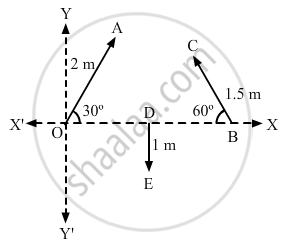
Refer to figure (2 − E1). Find (a) the magnitude, (b) x and y component and (c) the angle with the X-axis of the resultant of \[\overrightarrow{OA}, \overrightarrow{BC} \text { and } \overrightarrow{DE}\].
A spy report about a suspected car reads as follows. "The car moved 2.00 km towards east, made a perpendicular left turn, ran for 500 m, made a perpendicular right turn, ran for 4.00 km and stopped". Find the displacement of the car.
Give an example for which \[\vec{A} \cdot \vec{B} = \vec{C} \cdot \vec{B} \text{ but } \vec{A} \neq \vec{C}\].
The electric current in a charging R−C circuit is given by i = i0 e−t/RC where i0, R and C are constant parameters of the circuit and t is time. Find the rate of change of current at (a) t = 0, (b) t = RC, (c) t = 10 RC.
The changes in a function y and the independent variable x are related as
\[\frac{dy}{dx} = x^2\] . Find y as a function of x.
Round the following numbers to 2 significant digits.
(a) 3472, (b) 84.16. (c)2.55 and (d) 28.5
