Advertisements
Advertisements
प्रश्न
A carrom board (4 ft × 4 ft square) has the queen at the centre. The queen, hit by the striker moves to the from edge, rebounds and goes in the hole behind the striking line. Find the magnitude of displacement of the queen (a) from the centre to the front edge, (b) from the front edge to the hole and (c) from the centre to the hole.
Advertisements
उत्तर
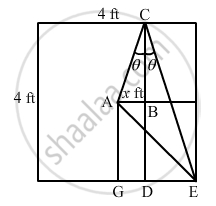
Consider that the queen is initially at point A as shown in the figure.
Let AB be x ft.
So, DE = (2 \[-\] x) ft
In ∆ABC, we have: \[\tan \theta = \frac{x}{2}\] ...(i)
Also, in ∆DCE, we have:
\[\tan \theta = \frac{\left( 2 - x \right)}{4}\] ...(ii)
From (i) and (ii), we get:
\[\frac{x}{2} = \frac{\left( 2 - x \right)}{4}\]
\[ \Rightarrow 2\left( 2 - x \right) = 4x\]
\[ \Rightarrow 4 - 2x = 4x\]
\[ \Rightarrow 6x = 4\]
\[ \Rightarrow x = \frac{2}{3}\text { ft }\]
(a) In ∆ABC, we have:
\[AC = \sqrt{{AB}^2 + {BC}^2}\]
\[= \sqrt{\left( \frac{2}{3} \right)^2 + 2^2}\]
\[ = \sqrt{\frac{4}{9} + 4} = \sqrt{\frac{40}{9}}\]
\[ = \frac{2}{3}\sqrt{10} \text { ft }\]
(b) In ∆CDE, we have:
DE \[= 2 - \frac{2}{3} = \frac{6 - 2}{3} = \frac{4}{3} \text { ft }\]
CD = 4 ft
\[\therefore CE = \sqrt{{CD}^2 + {DE}^2}\]
\[ = \sqrt{4^2 + \left( \frac{4}{3} \right)^2}\]
\[ = \frac{4}{3}\sqrt{10} \text { ft }\]
(c) In ∆AGE, we have:
\[AE = \sqrt{{AG}^2 + {GE}^2}\]
\[= \sqrt{2^2 + 2^2}\]
\[\sqrt{8} = 2\sqrt{2}\text { ft }\]
APPEARS IN
संबंधित प्रश्न
Some of the most profound statements on the nature of science have come from Albert Einstein, one of the greatest scientists of all time. What do you think did Einstein mean when he said : “The most incomprehensible thing about the world is that it is comprehensible”?
India has had a long and unbroken tradition of great scholarship — in mathematics, astronomy, linguistics, logic and ethics. Yet, in parallel with this, several superstitious and obscurantistic attitudes and practices flourished in our society and unfortunately continue even today — among many educated people too. How will you use your knowledge of science to develop strategies to counter these attitudes ?
What are the dimensions of volume of a sphere of radius a?
A unitless quantity
Find the dimensions of frequency .
Find the dimensions of electric field E.
The relevant equations are \[F = qE, F = qvB, \text{ and }B = \frac{\mu_0 I}{2 \pi a};\]
where F is force, q is charge, v is speed, I is current, and a is distance.
Find the dimensions of Planck's constant h from the equation E = hv where E is the energy and v is the frequency.
The height of mercury column in a barometer in a Calcutta laboratory was recorded to be 75 cm. Calculate this pressure in SI and CGS units using the following data : Specific gravity of mercury = \[13 \cdot 6\] , Density of \[\text{ water} = {10}^3 kg/ m^3 , g = 9 \cdot 8 m/ s^2\] at Calcutta. Pressure
= hpg in usual symbols.
Let I = current through a conductor, R = its resistance and V = potential difference across its ends. According to Ohm's law, product of two of these quantities equals the third. Obtain Ohm's law from dimensional analysis. Dimensional formulae for R and V are \[{\text{ML}}^2 \text{I}^{- 2} \text{T}^{- 3}\] and \[{\text{ML}}^2 \text{T}^{- 3} \text{I}^{- 1}\] respectively.
Test if the following equation is dimensionally correct:
\[v = \frac{1}{2 \pi}\sqrt{\frac{mgl}{I}};\]
where h = height, S = surface tension, \[\rho\] = density, P = pressure, V = volume, \[\eta =\] coefficient of viscosity, v = frequency and I = moment of interia.
Is a vector necessarily changed if it is rotated through an angle?
If \[\vec{A} \times \vec{B} = 0\] can you say that
(a) \[\vec{A} = \vec{B} ,\]
(b) \[\vec{A} \neq \vec{B}\] ?
Let \[\vec{A} = 5 \vec{i} - 4 \vec{j} \text { and } \vec{B} = - 7 \cdot 5 \vec{i} + 6 \vec{j}\]. Do we have \[\vec{B} = k \vec{A}\] ? Can we say \[\frac{\vec{B}}{\vec{A}}\] = k ?
The radius of a circle is stated as 2.12 cm. Its area should be written as
Let \[\vec{A} \text { and } \vec{B}\] be the two vectors of magnitude 10 unit each. If they are inclined to the X-axis at angle 30° and 60° respectively, find the resultant.
Draw a graph from the following data. Draw tangents at x = 2, 4, 6 and 8. Find the slopes of these tangents. Verify that the curve draw is y = 2x2 and the slope of tangent is \[\tan \theta = \frac{dy}{dx} = 4x\]
\[\begin{array}x & 1 & 2 & 3 & 4 & 5 & 6 & 7 & 8 & 9 & 10 \\ y & 2 & 8 & 18 & 32 & 50 & 72 & 98 & 128 & 162 & 200\end{array}\]
A curve is represented by y = sin x. If x is changed from \[\frac{\pi}{3}\text{ to }\frac{\pi}{3} + \frac{\pi}{100}\] , find approximately the change in y.
The changes in a function y and the independent variable x are related as
\[\frac{dy}{dx} = x^2\] . Find y as a function of x.
Write the number of significant digits in (a) 1001, (b) 100.1, (c) 100.10, (d) 0.001001.
