Advertisements
Advertisements
प्रश्न
A carrom board (4 ft × 4 ft square) has the queen at the centre. The queen, hit by the striker moves to the from edge, rebounds and goes in the hole behind the striking line. Find the magnitude of displacement of the queen (a) from the centre to the front edge, (b) from the front edge to the hole and (c) from the centre to the hole.
Advertisements
उत्तर
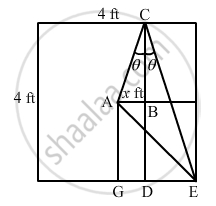
Consider that the queen is initially at point A as shown in the figure.
Let AB be x ft.
So, DE = (2 \[-\] x) ft
In ∆ABC, we have: \[\tan \theta = \frac{x}{2}\] ...(i)
Also, in ∆DCE, we have:
\[\tan \theta = \frac{\left( 2 - x \right)}{4}\] ...(ii)
From (i) and (ii), we get:
\[\frac{x}{2} = \frac{\left( 2 - x \right)}{4}\]
\[ \Rightarrow 2\left( 2 - x \right) = 4x\]
\[ \Rightarrow 4 - 2x = 4x\]
\[ \Rightarrow 6x = 4\]
\[ \Rightarrow x = \frac{2}{3}\text { ft }\]
(a) In ∆ABC, we have:
\[AC = \sqrt{{AB}^2 + {BC}^2}\]
\[= \sqrt{\left( \frac{2}{3} \right)^2 + 2^2}\]
\[ = \sqrt{\frac{4}{9} + 4} = \sqrt{\frac{40}{9}}\]
\[ = \frac{2}{3}\sqrt{10} \text { ft }\]
(b) In ∆CDE, we have:
DE \[= 2 - \frac{2}{3} = \frac{6 - 2}{3} = \frac{4}{3} \text { ft }\]
CD = 4 ft
\[\therefore CE = \sqrt{{CD}^2 + {DE}^2}\]
\[ = \sqrt{4^2 + \left( \frac{4}{3} \right)^2}\]
\[ = \frac{4}{3}\sqrt{10} \text { ft }\]
(c) In ∆AGE, we have:
\[AE = \sqrt{{AG}^2 + {GE}^2}\]
\[= \sqrt{2^2 + 2^2}\]
\[\sqrt{8} = 2\sqrt{2}\text { ft }\]
APPEARS IN
संबंधित प्रश्न
“Every great physical theory starts as a heresy and ends as a dogma”. Give some examples from the history of science of the validity of this incisive remark
What are the dimensions of volume of a sphere of radius a?
A physical quantity is measured and the result is expressed as nu where u is the unit used and n is the numerical value. If the result is expressed in various units then
Find the dimensions of linear momentum .
Find the dimensions of frequency .
Find the dimensions of
(a) angular speed ω,
(b) angular acceleration α,
(c) torque τ and
(d) moment of interia I.
Some of the equations involving these quantities are \[\omega = \frac{\theta_2 - \theta_1}{t_2 - t_1}, \alpha = \frac{\omega_2 - \omega_1}{t_2 - t_1}, \tau = F . r \text{ and }I = m r^2\].
The symbols have standard meanings.
Find the dimensions of electric field E.
The relevant equations are \[F = qE, F = qvB, \text{ and }B = \frac{\mu_0 I}{2 \pi a};\]
where F is force, q is charge, v is speed, I is current, and a is distance.
The height of mercury column in a barometer in a Calcutta laboratory was recorded to be 75 cm. Calculate this pressure in SI and CGS units using the following data : Specific gravity of mercury = \[13 \cdot 6\] , Density of \[\text{ water} = {10}^3 kg/ m^3 , g = 9 \cdot 8 m/ s^2\] at Calcutta. Pressure
= hpg in usual symbols.
Theory of relativity reveals that mass can be converted into energy. The energy E so obtained is proportional to certain powers of mass m and the speed c of light. Guess a relation among the quantities using the method of dimensions.
Test if the following equation is dimensionally correct:
\[h = \frac{2S cos\theta}{\text{ prg }},\]
where h = height, S = surface tension, ρ = density, I = moment of interia.
Test if the following equation is dimensionally correct:
\[V = \frac{\pi P r^4 t}{8 \eta l}\]
where v = frequency, P = pressure, η = coefficient of viscosity.
Let ε1 and ε2 be the angles made by \[\vec{A}\] and -\[\vec{A}\] with the positive X-axis. Show that tan ε1 = tan ε2. Thus, giving tan ε does not uniquely determine the direction of \[\vec{A}\].
A vector \[\vec{A}\] makes an angle of 20° and \[\vec{B}\] makes an angle of 110° with the X-axis. The magnitudes of these vectors are 3 m and 4 m respectively. Find the resultant.
Let \[\vec{A} \text { and } \vec{B}\] be the two vectors of magnitude 10 unit each. If they are inclined to the X-axis at angle 30° and 60° respectively, find the resultant.
A mosquito net over a 7 ft × 4 ft bed is 3 ft high. The net has a hole at one corner of the bed through which a mosquito enters the net. It flies and sits at the diagonally opposite upper corner of the net. (a) Find the magnitude of the displacement of the mosquito. (b) Taking the hole as the origin, the length of the bed as the X-axis, it width as the Y axis, and vertically up as the Z-axis, write the components of the displacement vector.
The changes in a function y and the independent variable x are related as
\[\frac{dy}{dx} = x^2\] . Find y as a function of x.
In a submarine equipped with sonar, the time delay between the generation of a pulse and its echo after reflection from an enemy submarine is observed to be 80 s. If the speed of sound in water is 1460 ms-1. What is the distance of an enemy submarine?
Jupiter is at a distance of 824.7 million km from the Earth. Its angular diameter is measured to be 35.72˝. Calculate the diameter of Jupiter.
